Monday, 17 December 2007

Radio Websites December 2007, published in Radio User, PWP Dec 2007


Welcome back again to the world of radio websites, as we take you on another tour of the wild, the wonderful and sometimes the plain simple but useful.

North American amble
Peter Jernakoff has built a website dedicated to his hobby of Medium wave DXing, which he describes as a “repository of DX recordings, logs, photos and links aimed primarily at the avid medium wave DXer. The recordings were obtained from my home in Wilmington, Delaware (USA). Give a listen, look around and enjoy yourself!” It’s a nice site with plenty of features, whether you want to browser through logs, help with some unidentified catches or check the QSL collection. Say hello too to Anna the Seal Point Siamese cat warming herself on Peter’s Drake R8B: http://www.21centimeter.com/

The links page will divert you down other enjoyable paths too. I was soon whiling away time at the home of the North American Time and Frequency stations WWV, WWVH, WWVB and CHU: http://www.geocities.com/radiojunkie3/

I was also just a click away from Canadian radio archive air-checks at: http://rockradioscrapbook.ca/ There are over 550 audio clips of stations and jingles from 1955 to the present, many with an accompanying report and photos. It’s difficult to stop yourself from clicking on ‘just one more’ and suddenly an unproductive, but very enjoyable, hour has passed.

Reader Mike Dawson M1ELK recommends the iWebRadio.com website, which advertises itself as ‘Radio...for Humans’. It is hosted at http://www.t35.com/~madchatt/HomePage/index.php This is a micro web broadcasting outfit consisting of both amateur and professional DJs producing their own programmes and broadcasting live on the internet. Programmes are then made available as podcasts. Listeners can join in the live shows with the DJs in the iwebradio chat room via the website. On Sunday afternoons you can hear Mountain View Radio with Jen the Radgirl followed by Aussie Tim then FM with DJ Vu. The station plays a lot of rare US rock and pop music plus a lot of international flavours.
If you fancy some Old Time Radio delivered in a new time technology, try the podcast at: http://www.otrpodcast.com/ It has American episodes from the 1950s of the Saint and Sherlock Holmes and CBS Radio Workshop, amongst others. For some Science Fiction Old Time Radio podcasts try: http://otrscifi.btpodshow.com/ “From its earliest time, radio has always been interested in Science Fiction. There has been science fiction on the radio since before Buck Rogers in 1932. Radio SciFi characters leaped into your living room as the listener would be taken on an adventure into time and space each week. Join us each week as we explore the unknown universe of science fiction only on the Old Time Radio Network.”


Ring out the old and ring in the new

ORF 1 / Radio Austria International still broadcasts in English, daily with ‘Report From Austria’ and the weekly ‘Insight Central Europe’ collaborative broadcast. Details and an online reception report form are at their website: http://oe1.orf.at/service/international
Many podcasts are also available, mostly in German but also French and English: http://oe1.orf.at/podcast/

BBC World Service Director of News Helen Boaden looks back over 75 years in one minute clips. Just click on a decade to read about and hear gems of BBC WS and of history itself: www.bbc.co.uk/worldservice/specials/1122_75_years/index.shtml
There is a My Space BBC World Service fansite at: www.myspace.com/bbcworldservice There are regularly updated blogs describing the past and present of the station, a gallery of photos of Bush House, QSL cards and past presenters, and the promise of a number of audio files to come. The respectful, almost regal deep blue backdrop and the typewriter font add to an air of grandeur and history.

If you remember the 8 track cartridge then you are older than me! This format was popular in the 1960s and 1970s and there are quite a few collectors out there, so inevitably there are a number of websites too, including an 8 Track Cartridges web ring, linking many of the groups together. Some nice overviews of the music released on cartridges and the background at:
http://homepage.ntlworld.com/hamidk/8-tracks.htm “8-track tapes originated in America in the 1960s. They were primarily designed for playing pre-recorded music in cars and trucks, but home and portable players were made, too. There were even some recordable 8-track decks. 8-track was a huge success in the U.S. until the now familiar audio cassette took over in the later half of the '70s. Outside the American "car culture", 8-tracks were less popular. They were made and sold in Britain for several years. In most other countries they never appeared at all.” And when your old 8 cartridges break, Jeremy Larsen will show you how to fix them, at: http://www.geocities.com/Paris/4831/8tracks.html


Christmas wish list

The World QSL Book is a comprehensive resource and reference book on CD for any hobbyist who is interested in acquiring a verification of reception of almost any HF station, whether broadcast, utility, amateur radio, or unlicensed pirate or clandestine! This 528-page eBook covers every aspect of collecting QSL cards and other acknowledgments from stations heard in the HF spectrum. This self-loading, easy-to-use reference begins with a comprehensive tutorial on how to QSL (verify) radio stations followed by address sections for broadcaster and utility stations. It is loaded with station addresses, Internet websites, and e-mail addresses. Coverage includes shortwave broadcasters (including clandestine and pirate stations); HF utility stations (civilian and military); and amateur radio QSL bureaus worldwide. It is the first comprehensive publication of its kind devoted to QSLing radio stations in the HF radio spectrum. The World QSL Book is published in Adobe Acrobat (PDF) electronic format and is fully searchable/printable. Teak Publishing. http://www.universal-radio.com/catalog/cd/1183.html


If you want to send a Christmas e-Card from ABC Australia, more specifically linking to the Aboriginal radio network, go to
http://www.abc.net.au/message/contact/ecards/christmas.htm It is part of Message Stick which is an ABC indigenous radio station.
Other Christmas e cards from ABC can be seen and sent at: http://www.abc.net.au/alicesprings/ecards/

If it is a more traditional Christmas card, albeit by electronic means, that you are looking for try some of the following web addresses:
BBC Radio Leicester offer animated cards at: http://www.bbc.co.uk/leicester/ecards/xmas_postcard.shtml
Their colleagues at BBC Kent have a wider range (Leeds Castle in the snow is my favourite) at: http://www.bbc.co.uk/kent/christmas/e_cards.shtml

Finally, for an all singing and all dancing (I kid you not) range of Christmas cards, the travel bookmark website takes the honours. Throughout the year they produce some tasteful travel postcards of Lake Garda scenes at: www.travelbookmark.com/cards/gardalake.shtml but come this time of year and festive fever seems to won over good taste, at: http://www.travelbookmark.com/cards/xmas.shtml

Friday, 9 November 2007

Radio Websites (Published November 2007 in Radio User, PWP)


Have your mouse at the ready, the speakers turned up, and join me for a Brazilian blend of bossa novas and berimbaus (the latter is a musical instrument). Afterwards we chill out with a tour of space- My Space that is, and some of the thousands of radio profiles set up on the ever-expanding social interaction site.

Tropical bands on Tropical bands
Hearing music from exotic countries is one of the many areas where the Internet excels. With the decline in numbers of shortwave Tropical Band stations, there is a growing need for listeners outside of the tropics to turn to Internet radio for fixes of funk or tastes of tango.

Internet radio is undoubtedly ‘the future today’ and a way into radio listening for many young people, most of whom wouldn’t know their squelch from their elco (capacitor). But in all honesty, why should they? It is a shame that low powered domestic radio stations are leaving the tropical bands for FM transmitters, but technology evolves, and we should all embrace the opportunity to effortlessly tune into radio from any country on the planet.

If however you would like to read up on the latest information on radio on the tropical bands, try the Danish Shortwave Club International: http://www.dswci.org/ and http://dswci.org/specials/conferences/edxc_lecture/article.html
Also are specialist knowledge is at ‘DXing Info’: http://www.dxing.info/ and Willi Passmann’s Radio Portal:
http://www.radio-portal.org/wp/index.html


Favela funk flavours
On to online radio to concentrate on some Brazilian beats. Along with traditional sounds such as samba and bossa nova, a more recent style of music to come from the boys (and girls) of Brazil is labelled favela funk. Favela being the name for the shanty towns that sprawl the outskirts of far too many Brazilian cities.

There are thousands of Live 365 stations and it’s always difficult to choose the better ones, but here are two for starters. From Lisbon in Portugal comes ‘Broadcastor’ which plays a great selection include Bossa Nova, Jazz-Samba and MPB (Brazilian Popular Music). “All the classics and many lesser known gems, not forgetting the more recent breed of Brazilian artists.” A good thing about this station is that the playlist is changed at least twice a month.
http://www.live365.com/stations/broadcastor

Radio Electric Brazil is based in the north-eastern Brazilian state of Salvador and offers ‘electro, Brazilian and tropicalia’. I am not sure which is which but most of what I have heard sounds pretty good to me: http://www.live365.com/stations/electricpardal

The very stylish Radio Cubik Network website has online radio stations including Radio Tango (‘experience the passion of Buenos Aires’); Radio Salsa, with of course salsa, Latin jazz and meringue; Bossa Brazil with bossa nova, samba and the soothing sounds of Brazil. There are other sounds too, such as Poetry Mission, which is for ‘romantics entrapped in the digital age’: http://www.bossabrazil.com/

‘Brazil Drums’ is a USA based commercial company selling Brazilian instruments, but a fascinating website whether you are browsing or buying: http://www.brazildrums.com/main/


My Space Radio
Unsurprisingly, the Facebook, Bibo and My Space phenomena has led to many profiles of radio stations and presenters appearing. Of these three social interaction networks, I have only really explored My Space so far, which itself is a major undertaking. Here are some of my recommendations.

Some of the many fan sites that I enjoy or have linked with include the BBC Radiophonic Workshop: www.myspace.com/bbcradiophonicworkshop This goes back to the famous day in 1963 when the Workshop came up with the original theme tune for Dr Who. It is also a tribute to others who passed through over the past four decades, including Delia Derbyshire, who has even had a BBC play based on her life broadcast on BBC Radio 4 and BBC 7.

Evergreen Radio Caroline has several different profiles set up by fans. These include Radio Caroline ‘The Independent Spirit of British Radio Since 1964’ at: www.myspace.com/pirateradiocaroline
and Caroline Classics at: www.myspace.com/carolineclassics

On My Space it is often hard to tell apart the pages set up by the real person and those purporting to be the profile of somebody famous. It can be a case of viewer beware! Russell Walker hosts BBC Radio Leeds’ late night show. A brick wall is the backdrop to his page and there is a nice set of You Tube links, a potted biography and a good slide presentation of him in the studio: www.myspace.com/russell_walker_late_show

Dotun Adebayo, outspoken columnist and one of the presenters of Radio 5’s Up all Night show. Catch up with his views through his blog and his latest projects, all set to music that he sings himself: www.myspace.com/dotunadebayo

DJ Marc Riley is at: www.myspace.com/marcriley presenting music he likes and a link to his BBC 6 web pages. American radio legend Wolfman Jack can be seen at two sites: www.myspace.com/the_wolfman_jack and www.myspace.com/wolfmanjackshow An example of a affectionate spoof site is of Radio 4 and Mastermind’s John Humphreys: www.myspace.com/johnhumphrys


Bill Buckley is a broadcaster and journalist with, amongst others, LBC and BBC local radio. He has a bright, breezy and informative website at: http://www.billbuckley.net/ As well as reviewing the newspapers and issues, he is a bit of a culinary master on the side, a member of the Guild of Food writers and even a winner on the excellent Channel 4 programme ‘Come Dine with Me’.

Finally this month a lesser known author of an interesting blog who goes under the name of Madrid Kid. Lots of information about shortwave radio, television and radio in Spain and some very well written pieces: http://madridkid.blogspot.com/2006_01_01_archive.html My only gripe is that the blog hasn’t been added to for 18 months! But the archive is still good quality journalism, just like the magazine that you have in your hands is! Happy browsing until next month.

Radio Websites (Published October 2007 in Radio User, PWP)


Pick of the podcasts
The plethora of podcasts available makes choosing which ones to subscribe to, or even hear one edition of, a tough choice. As you could predict with a technology that enables anyone to produce their own programmes, the quality varies considerably. From unhinged rants to high quality investigative journalism, with a lot falling in between.

If you are of a certain age you may want to listen to the nostalgia of an old night time medium wave favourite, Radio Luxembourg. Podcasts are becoming available from the station’s pop heydays of the 1960s and 1970s, as well as the 1980s. There are regular additions from all eras and it is worth at least a listen to two: http://www.radioluxembourg.co.uk/

For podcasts of modern day international radio favourites, the World Radio Network (‘Seeing the world through radio’) is a good podcast portal. WRN rebroadcast many stations’ output on satellite and the internet, and you can also access podcasts too. Stations on the list include the Voice of Russia, Radio Slovakia and Radio Romania International. The pick of these is the Voice of Russia’s educational and entertaining historical programme ‘Our Homeland’, and the weekly ‘Europe East’ from Radio Polonia. http://www.wrn.org/listeners/stations/rss.php?id=23&s=eu
also http://www.wrn.org/listeners/stations/podcast.php
and http://www.wrn.org/


A selection of varied and interesting podcasts from New Zealand can be heard at the following website: http://www.podcastnz.com/, including Radio New Zealand’s Checkpoint Choice, Science Story and the digital technology programme Virtual World, with Hamish MacEwan.

A blog celebrating radio jingles makes for an interesting read at: http://www.jinglenews.com/
The Jingle Network blog has been online since January 2005, and includes podcasts, news and samples of radio jingles from around the world. If you are into jingles you will want to read this, but if you consider them to be anorak territory you should read and listen and be pleasantly surprised. The most recent Jingle Network Podcast offered typical variety and contained: KCFM, Radio Globo, New Reel World jingles for local stations in Portugal, Spain Switzerland, and the USA.

Not a podcast as such, but well worth using the BBC’s brilliant ‘Listen Again ‘ facility for is the following gem from BBC Radio Ulster. John Bennett's Radio Years is a thirty minute weekly programme which goes out on Sunday afternoons. Or of course, whenever you want to hear it if you click on ‘Listen Again’. “Relive the highs and lows of days gone by as they are portrayed in the BBC Northern Ireland Archive. Do memories mature like good wine or go sour as they age?” Recent programmes I have enjoyed featured the years of 1941, which was a fascinating history lesson for me, and 1986, which was a trip back to my youth: http://www.bbc.co.uk/northernireland/radioulster/radioyears/


A small Scilly world
Launched on 107.9 FM in early September, Radio Scilly proclaims itself to be the world’s smallest radio station. They broadcast from an attic studio in Porthmellon, with an aerial at the Telegraph coastguard tower: http://www.radioscilly.com/ You can contact them by e-mail at: studio@radioscilly.com

At the moment the website is more of an illustrated blog, which itself is a nice look behind the scenes at all the work involved in setting up a radio station. Hopefully this will develop and include audio streaming and podcasts at some stage, so that the small voice can shout loud to the world. A webcam at the council website also covered some of the opening events and may link regularly with the station: http://www.scilly.gov.uk/

Websites by the wayside
The ‘Internet Archive Wayback Machine’ is a very useful website in that it stores old web pages. Many websites come and go, often removed because of hosting costs rather than author fatigue. With millions of websites stored, the ‘Wayback Machine’ is a great resource to turn to when you are faced with that perennial problem of returning to a website that you were sure was there a few months ago, or maybe it was a year or two that you last visited it. I am sure you recognise the scenario along the lines of: ‘Help, where has that site gone, I know it contained some vital information I need right now’. Putting it to the test, I managed to retrieve quite a few pieces of research that I had bookmarked several years back and were on websites that had since fallen by the wayside: http://www.archive.org/web/web.php

A miscellany of marvels
The technology behind FM radio was developed in the late 1930s, and FM radio itself became a commercial viability in the 1950s. The story behind FM , and pirate radio, is amongst many other fascinating facts and features at the ‘Rewind the Fifties’ website. Type ‘radio’ into the search box at the site: http://www.loti.com/

To end with this time, a reminder of one of the long-running and much loved websites serving the DX community for almost a decade. Dave Kernick’s Interval Signals Online: http://www.intervalsignals.net/ This is an indispensable treasure trove of interval signals, signature tunes and identification announcements from international, domestic, and clandestine radio stations around the world. Easy and effective to use it contains a massive collection of audio clips of foreign radio stations, with identification announcements in various languages, signature tunes and jingles, and of course, interval signals.The website undergoes regular development, with new sound-clips beingadded to the collection and existing ones modified. You simply click on a country name from the menu on the left of the site, then click on a station name to play the MP3 sound clip.

Friday, 2 November 2007

From the archives:Hack Green Nuclear Bunker

Hack Green Nuclear Bunker
By Chrissy Brand
Published in Radio Active (January 2003)

“Right under the noses of the one million inhabitants of Cheshire lurks a secret government building; Hack Green Nuclear Bunker”


From the late 1970s and through the 1980s, at the height of the Cold War, the British government invested in Cruise Missile systems and extravagent Home Defence plans in the form of underground nuclear bunkers to house key military personnel and civil servants, should the unthinkable happen.


Cold War in Cheshire
The success operation of the system of nuclear bunkers installed across the United Kingdom, and other NATO territories, depended upon the latest communications devices. In the peaceful surroundings of Cheshire lies a building that was designated as the regional centre of government for the north-west of England should the Cold War have ever escalated to a nuclear war.

This relic of the Cold War that recently came to light is set in rural south Cheshire. Under the noses of the one million inhabitants of Cheshire, in one guise or another for the past 50 years, firstly as a RAF base and then as a sinister Home Office building; Hack Green Nuclear Bunker (cue dramatic music). The history of military sensitive locations such as Hack Green cannot fail to be of significant interest to anyone who follows military or communications matters.

Whilst to the north of the county Jodrell Bank is famous for the output of its radio telescopes project set up in 1947 to scan space, (and expertly covered in last July’s Radio Active by Lawrence Harris), over the same period of time to the south of the county Hack Green had been maintaining top secret status.


Cold War Conduct


The Cold War reached its dangerous zenith by the early 1980s. Nuclear weapons were building up on both sides, and the Soviet Union gerontocracy headed by President Leonid Brezhnev was in conflict with the right wing ideology of President Reagan and Prime Minister Thatcher. Hundreds of thousands of anti-nuclear protestors (such as CND, the Campaign for Nuclear Disarmament) took to the streets in west and east and the spectre of a nuclear attack was prevalent in the public mind.

The Cold War really commenced after World War II, when the ideological differences between the Allies that had been put aside from 1939 to 1945 became insurmountable. The Soviet Union and Communism’s influence on eastern Europe increased, sometimes by force and sometimes by the ballot box.

To counter what they saw as a threat, the western Allies formed NATO (the North Atlantic Treaty Organisation) in 1949. The Eastern European countries formed their own military alliance six years later, the Warsaw Pact. From there on the nuclear age started to spiral out of control. The 1950s and 1960s saw the nuclear age escalate with the production of thermonuclear weapons and intercontinental ballistic missiles (ICBMs).

NATO and the Warsaw Pact continued to stockpile a nuclear arsenal large enough to destroy the world several times over. Near-war scenarios and clashes were somehow overcome, such as the 1962 Cuba Missile crisis. Presidents came and went in Washington and Moscow, including Eisenhower, Kennedy, Nixon, Reagan; Stalin, Khrushchev, Brezhnev. It wasn’t until Gorbachev initiated policies of glasnost and perestroika in the mid-1980s, that the Cold War really began to thaw, melting away with the Warsaw Pact finally disbanding in 1991.

Despite occasional agreements to limit nuclear weapons, such as the 1968 Non-Proliferation Treaty and the first Strategic Arms Limitations Treaty (SALT) in 1972, the world was under the constant threat of a nuclear war between east and west, be it intentional or accidental.

Nuclear winter
Setting off to investigate Hack Green on a chill winter's day certainly helped recreate the mood of undercover agents in trenchcoats and trilbies. Being followed from the M6 heading towards Hack Green by a juggarnaut from Moscow added to the atmosphere. The sight of an articulated lorry with cyrillic script stating it had arrived overland from Moscow would have triggered a major security alert a couple of decades ago. In the early 21st century it is an example of how times have changed and how the victors of the Cold War were international commerce and the free market.

The site of the Hack Green bunker is well hidden, as you would expect, located amidst Cheshire farmland, not far from the town of Nantwich, where the salt mining industry once thrived. (Nantwich, Middlewich and Northwich being Cheshire’s equivalent of the infamous salt mines of Siberia, but without the political prisoners).

I drove through winding country lanes and eventually came across some fenced off fields. Through the wire fence I could see a bland low brick ochre coloured building. Atop this is a 35 metre radio tower, and in a field to the left is a radar antenna. This is a Marconi type 264 A/H radar antenna installed in 1962 as part of Hack Green’s Air Traffic Control role.


Hack Green History
Hack Green’s military history stated in World War II and remained highly sensitive until declassification in 1993. In 1941 RAF Hack Green became one of the 21 U.K fixed radar (Radio Angle Direction and Range) stations, and was amongst the 12 that were also fully equipped with search-lights and fighter aircraft control.

In the 1950s it was used as part of the secret radar network codenamed Rotor. Rotor was an upgrading of the nation’s radar network and involved placing 1620 radar screens into bunkers across the U.K. Working at the base at that time were 18 officers, 26 NCOs and 224 corporals.

By1958 RAF Hack Green had become part of the U.K ATC (Air Traffic Control) system, providing safe radar-assisted flying for military and civil aircraft. This operation was transferred to RAF Lindholme, Yorkshire in 1966 and RAF Hack Green was shut down.

Ten years later in 1976 the Home Office Emergency Planning Division bought the abandoned station from the Ministry of Defence. It had a new role, to become the centre of regional government in the event of a nuclear war. The British government designated 11 Home Defence Regions covering the U.K. Scotland, Northern Ireland and Wales were assigned numbers 1, 11 and 8 respectively. England was divided into 8 geographical regions. Region number 10 was split into two with 10:1 covering Cumbria and Lancashire and 10:2 covering Greater Manchester, Merseyside and Cheshire.

So from 1976 to 1984 Hack Green was rebuilt as a secret nuclear bunker, at a cost of £32 million. It covers over 35,000 square feet on three levels, and the money bought protection, but a daunting prospect, for 135 civil servants and military personnel. These would be amongst the survivors should a nuclear device detonate in the north west.

A complex communications infrastructure included a BBC studio and telecommunications links to the other Home Defence Regions and key government and military installations. The bunker was also equipped with a generating plant, air conditioning and life support, nuclear fallout filter rooms and emergency water supplies.


Going Underground
Before entering the reinforced concrete bunker I had a look at the cockpit section of a McDonnell Douglas F4 Phantom II, on display outside the entrance. This was designed as a fleet defence fighter for the U.S Navy, with the U.K the first country to import them, back in 1964. Now acknowledged as the most potent jet fighter ever, the 5,195 that were made over a 20 year period saw combat in Egypt, Iran, Iraq, Israel, and Vietnam. Leaving behind the cockpit of XV490, which saw 23 years service and is maintained by the Phantom Preservation Group, I entered the bunker.

The bunker is on three levels, with Underground Level One built to contain Government Headquarters, an administration centre and technical departments, and
Underground Level Two the location for a Communications centre, BBC studio, Scientists, Minister of State, and life support systems.

Commanding the bunker would be a Commissioner, either a minister or appointed civil servant, with his own quarters. He, along with a Principal Officer, Deputy Principal Officer, Deputy Secretary, Assistant secretary and a secretariat of seven would form the Cabinet of any post-war regional government.

The small BBC radio studio and adjacent office is part of a Wartime Broadcasting Service. A nuclear strike would disable television networks, so radios would be the main form of communicating to survivors.

Engineers would operate the equipment for broadcasts which would include emergency announcements and orders of the commissioner. Officers from the Central Office of Information would also provide bulletins and information to be transmitted, both in the build up to a war and afterwards. The Commissioner could speak directly to survivors from the BBC studio if he deemed it necessary.


There was a separate radio room for military communications to transmit and receive. The division between military and civilians could have only added tension at a time of tension and total uncertainty.

As well as the BBC, British Telecom had a role to play. Their equipment was used to operate the ECN (Emergency Communications Network). This was the Regional Government HQ’s own communications network which covered the whole country and was supposedly protected from attack. Latest messages from around the regions would appear on VDUs (Visual Display Units), this being an Internet equivalent of the time.

There was an distinct eerieness as I walked the cream and green painted corridors. Yellow and black radiation symbols marked off some areas, other signs reminded you to wear your dosemeter and murmured discussions could be heard in dully lit rooms. Teleprinters whirred, agonised screams emanated from sick bay, bleak tannoy announcements and sirens pierced the gloom. “Today’s Alert State is Bikini Black Alpha”, “Attack warning Red”…

The Sick Bay mentioned above was a small room with just a couple of beds and only two medics, a doctor and nurse. They were unable to help a dummy patient dying ftom radiation sickness, complete with plastic vomit in a bowl for added realism.

One large room contained a generator power supply.There are two large generators which could supply up to 600kVA, which is enough to light up a small town. All life support and air conditioning systems could be remotely controlled from this area. The air would be cooled, filtered, dehumidified and heated to maintain a 20° C temperature. There was an emergency water supply of 68,000 litres (15,000 gallons) which via the pumping station would reach all main services in the bunker.

For me, one of the most striking and unsettling rooms was also one of the most simple. One office houses 23 desks for Civil Servants. On each desk is a telephone and name plate showing the government department or agency represented. These included familiar departments such as the Departments of Health, Energy, Transport, Trade and Industry, Local Government, Home Office Emergency Planning and even the Inland Revenue.

Specialist departments, or individual civil servants, set up to deal with the situation in a post-nuclear world included a Property Services Agency, Refugees, Buffer Food Depot, a Burial and Disposals Officer, Judiciary and Water, Ports and Shipping. All of these posts would assist the commissioner should there be any non-contaminated region left to govern over.

A degree of normality is preserved by the tea urn in the corner, although I doubt if the loyal tea lady had a place reserved for her in the bunker. Whilst taking all of this in, I overheard a mind numbing discussion between some of the civil servants, advising a wartime radio broadcast to state that dead relatives and friends should be placed outside in the street to await twice daily collections.

Another civil servant announced the bearings of the latest bomb drops, information obtained from the Attack Warning room next door. Information of imminent missile attacks would have been received via the ballistic missile warning station at Fylingdales in Yorkshire, or the U.K regional air operations centre at High Wycombe. A further roomful of scientists would plot the spread of radioactive fallout and the movement of refugees across the country.

The equipment on display looked hopelessly out of date. Such is the advance in communications technology in the past decade, that even a current home computer seems more powerful. £32 million doesn’t go a long way and I can understand why the bunker was declassified and opened as a museum. Hopefully any replacement regional bunkers around the country might be able to invest in communications equipment with better longevity.

I can’t help but feel that whatever communications network is installed, a biological, chemical or nuclear attack would create such a hopeless situation in the vicinity that any emergency survival systems would be in vain. Better to evaporate at the epi-centre than to slowly starve underground with the civil servants.

The Government public advice films running at the bunker contain almost laughable advice in the event of a nuclear attack. Many of the public and the anti-nuclear movement thought they were nonsense even at the time. A 1970s British film advises on taking plenty of strong disinfectant and toilet paper with you into the home made fall out shelter (two doors propped against the wall). A 1950s American film suggests you fire-proof your home and ‘set aside a small supply of canned food; they’re safe from radioactivity. A radio will be important for receiving vital instructions’. Should you be caught outside at the time of a blast you need to ‘duck and cover’- the name of one of the more famous fatuous public advice films of the time.

A shower room in a bunker takes on a whole new meaning. Engineers who had to leave the bunker to service the generators would wear specialised clothing to protect against radioactive fallout, which would then be discarded. It was unclear just how many of these items of clothing there were. After a shower to remove any fallout, a quick check with a geiger counter was required before returning to the main bunker.

Other attractions
There are many other displays and attractions to investigate. The Radar Ops Room includes a history of radar from World War II to the 1990s, and includes a Nimrod airbourne radar display used for anti-submarine and search and rescue. You can see a World War II T1154 radio transmitter, which was the main transmitter used by Bomber Command during that war.

Take a close look at one of Her Majesty the Queen’s War telephones. These old style black and green telephones with a royal crest were installed at all Royal residences. They were connected to a voice scanner for secure and secret communications. If the U.K had been threatened by a nuclear war the Prime Minister, advised by the War Cabinet, would phone for Royal assent for the enforcement of the Emergency Powers Act, and the dissolution of Parliamnet, which would put the U.K onto a war footing. These days the Queen can presumably be contacted by an encrypted mobile phone.

Other items of interest include the history of the Royal Observer Corps, missiles such as a Chevaline nuclear warhead, geiger counters, a Soviet Enigma machine and an East German Morsegeber. The latter was an advanced transmitting and receiver unit used in the 1980s to send secret code in Russian Cyrillic, German, English, Morse or RTTY.

Elsewhere in the bunker there is an old military radio, for visitors to tune into war time broadcasts. Tuning in on 450 metres I heard some chilling news bulletins.

The Soviet threat room houses a fine collection of Warsaw Pact flags, pennants, uniforms, rifles and transmitting and receiving equipment, all set to the background of an echoing Russian radio broadcast. A NATO booklet from 1972 should be read, memorised and then destroyed- ‘The Warsaw Pact- Know their weapons and equipment’.

Soviet Union medal ribbons on display date from the Russian Revolution through the Great Patriotic War (Russian’s name for World War II) and onward. The medal for Order of Glory, Partisan of the Patriotic War, medals for the Liberation of Belgrade, Budapest. For the capture of Vienna, Odessa, the defence of Leningrad, Stalingrad, Sevastopol, the Order of Lenin. Has a single country ever issued so many different medals?


Conclusion
In the event of a nuclear war, or even a nuclear detonation, affecting north-west England, it is difficult to imagine that there would be many citizens left to for the elite personnel at Hack Green to actually govern over. Hundreds of thousands of those not vapourised at the epi-centre would be dying from radiation sickness within weeks. The remaining population, would either starve or be unable to survive from the desolated landscape. The survival of the fittest would take on a whole new meaning, with even the fittest liable to contract cancers of some kind or other. The explosion at Ukraine’s Chernobyl nuclear power station in 1986 led to a dramatic increase in leukaemia, cancers and birth defects in the region. However, the Chernobyl disaster would be minor compared to a nuclear attack envisaged and prepared for by installations such as Hack Green by British governments since the 1950s.

Those of us that survived the Cold War unscathed can look back at it with some bizarre degree of nostalgia. With hindsight it was a period of peace, albeit an uneasy peace, in Europe. History and closure makes it easy to underestimate the dangers of conflict in that period.

Chillingly it seems to me that Hack Green and other similar installations are more likely to be needed in the current uncertain age. The threat of suicidal terrorists and unstable regimes using nuclear, biological or chemical weapons appears greater than the use by NATO or the Warsaw Pact in the Cold War. The legacy of nuclear arms and the dangers of their use by terrorists or rogue states has replaced the uneasy peace of the Cold War with perhaps an even more dangerous nuclear age in the early 21st century. Presumably there are modern day equivalents to Hack Green secreted away in the British countryside, with up to date communications equipment, and a similar restricted list of key personnel on red alert standby.

Hack Green will never have to be put on red alert or fulfil its original purpose. Instead, it serves as a chilling reminder of the Cold War. In 1999 it won a North West Tourist Board tourism award. It is open to the public at weekends in winters (although is closed for all of December) and daily from late March until October. Tel: 01270 629219. There are other similar bunkers open to the public around the U.K, such as the Underground Nuclear Command Centre near St. Andrews, and Kelvedon Hatch bunker in Essex.

You can round off the experience with a cup of tea in the NAAFI (the canteen for Navy, Army and Air Force Institutes) , before perusing some of the unusual souvenirs on sale. These include Red Army hats and badges, British ration books, copies of the 1945 Radar Bulletin, and authentic Soviet Union Party membership books.

Personally I was so shaken by the whole experience that I just wanted to exit to the daylight to ensure that the world as I know it was still there. So it was a relief when I was back in the more familiar tranquility of Cheshire, sitting by Nantwich Lake, just three miles from the heart of the bunker. Out of range from the BBC Wartime broadcasts, instead I gratefully tuned the car radio to the lighthearted banter of BBC Radio Shropshire on 96.0 MHz. Rarely have I been so grateful for the inane chatter of a radio phone in, easing me back to reality and helping chase away the ghosts of Hack Green nuclear bunker.


Wednesday, 29 August 2007

Undercover, over airwaves - Dipping into Clandestine Radio


Undercover, over airwaves -Dipping into Clandestine Radio
By Chrissy Brand


First published in Radio User, PWP Ltd February 2006

Flag- Voice of Biafra International


Ever since the first radio stations took to the air providing entertainment or political agendas, there have also been those with opposing views or aims struggling to be heard. In democracies, the removal of unpopular politicians can usually be achieved through the ballot box, but on almost every continent there have been cases where opposition parties, counter-revolutionaries, intelligence agencies and others have turned to clandestine radio stations to get their views across.

From propaganda or voices of freedom over wireless waves to the Internet, clandestine broadcasters have used whatever means possible to get the message to their target audience. The first clandestine radio station was used by Russian communists to encourage German workers to support the Russian revolution. Radio was in its infancy then but the Russian Revolution’s leader Lenin was aware of its power. He reportedly stated radio was a ‘newspaper without paper and without frontiers’.


BBC Monitoring defines clandestine sources as ‘those which do not specify their location, which specify an imprecise location (e.g. ‘liberated territory) or which falsely claim to emanate from a particular location.’


Historical stations

Wartime is a prime time for governments and intelligence agencies to consider running clandestine radio stations. Britain’s earliest radio PYSOPS, or Psychological Operations, was probably in World War II. Sefton Delmer was the man behind stations such as 'Soldatensender Calais' and 'Der Chef'. These broadcast to the German troops in Europe, purporting to be German backed stations. They subtly and successfully spread disinformation and lowered morale amongst the target audience.

In the 1982 Falklands Islands conflict a station called Radio Atlantico del Sur (South Atlantic) was set up on Ascension Island by Britain. It broadcast news, music and sport to Argentine troops with the slogan ‘Bringing Truth to the Front’.


Central and South America is a more politically and economically stable region today than it was from the 1950s to 1980s. In those decades it was a hotbed of clandestine radio stations espousing many varied political causes. The CIA-backed Radio Swan (1960s) and today’s Radio Marti aimed to overthrow Fidel Castro’s Cuba. Other clandestines to come and go amidst the 1980s political upheaval and revolutionary turmoil in Latin America included: 1980s Radio Free Suriname, Nicaraguan stations La Voz de Sandino and Radio Monimbo, Radio Venceremos in El Salvador.


Whilst most operators behind such stations remain anonymous or unknown beyond their national arena, some have gone on to become major political figures. One example is Che Guevara who moved to Guatemala in 1954, then a sanctuary for Latin American political liberals. He witnessed how a CIA clandestine radio station, ‘La Voz de la Liberacion’, almost single-handedly overthrew Guatemala's elected leftwing government. Guevara came away with both a strong distrust of the United States and an appreciation of the radio's role in warfare.

Another example was in South Africa under the apartheid regime, where stations were operated by opposition movements including the ANC. In the early 1960s ANC activist Walter Sisulu broadcast weekly from a clandestine radio transmitter on a farm on the outskirts of Johannesburg. Not long afterwards in 1964 he was imprisoned on Robben Island for 28 years along with Nelson Mandela.

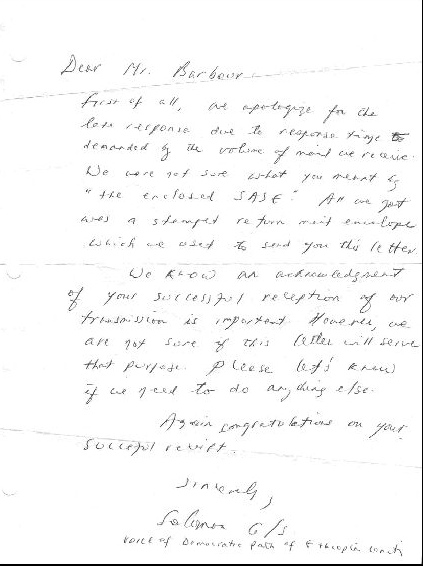
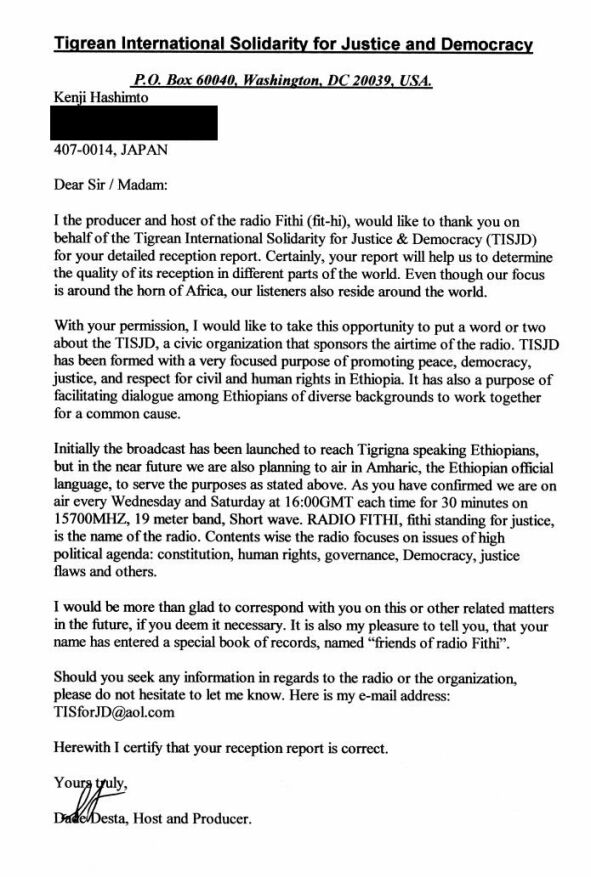
The 1980s and 1990s conflicts between Ethiopia and Eritrea caused the Horn of Africa region to become the focus of a bewildering range of clandestine radio activity. Before and after Eritrea’s 1993 independence from Ethiopia, dominant clandestine voices in Eritrea were the ‘Voice of the Broad Masses of Eritrea’ and ‘Voice of Democratic Eritrea’, whereas Ethiopia was inundated with the views of ‘Radio Rainbow’, ‘Radio Freedom’, ‘Voice of Oromo Liberation’, ‘Voice of Ethiopian Unity’, ‘Voice of the Democratic Path of Ethiopian Unity’, ‘Tigrean International Solidarity for Justice and Democracy’ and ‘Radio Fana’. Some of these stations are still on air today.


Across Africa, in the late 1990s and early 2000s Nigeria had three active clandestines, in the form of ‘Radio Kudirat International’, ‘Radio Nadeco’ and the ‘Voice of Biafra International’. The latter is currently still on air in English, heard recently on 7380 kHz at 2100 UTC.


Going back in time, a spate of clandestine stations sprang up in China in the wake of the 1966 Cultural Revolution. Although from different factions they shared an anti-Mao Zedong message. In 1967 several clandestine stations were thought to be based within China. Two went by the names of ‘Jiefangjun zhi Sheng’ (The Voice of the Liberation Army) and ‘Huohua‘ (Spark).

Some of them continued to broadcast even after the revolution ended 10 years later but had vanished by 1991. The identity of many of those behind the broadcasts still remains a mystery. There were a couple of notable exceptions however, with two stations identified as coming from, and being backed by, the Soviet Union.

In 1988 a Japanese DXer recognised the voice of an announcer at ‘Red Flag Broadcasting’ as the same announcer heard on the Chinese service of the U.S.S.R’s ‘Peace and Progress’ station. Independent research confirmed that ‘Radio 8.1’ originated from the Vladivostok region and that Red Flag Broadcasting Station was located near Khabarovsk.

In the wake of the 1989 Tianaman Square massacre a new station called the "Voice of Democracy Broadcasting Station" was heard daily on 8057 kHz but disappeared in 1991.

Current clandestines
There are many parts of the world in political turmoil and where oppressed voices are striving to be heard. How they are defined can depend on the individual’s viewpoint; Opposition groups, freedom fighters, guerrillas, terrorists, counter-revolutionaries…the definitions are controversial and a separate debate. However, current clandestines are predominantly heard today in Asia, the Middle East and parts of Africa.

Zimbabwe
If the definition of a clandestine station is that their operating base and transmitter sites are shrouded in secrecy then ‘SW Africa’ doesn’t quite fit the bill. Maybe it is a model of a 21st century, pro-democracy, opposition-in-exile clandestine station.

Since 2001 it has been broadcasting to Zimbabwe, as an independent voice of that country. It has been playing cat and mouse and being jammed by the authorities on shortwave and medium wave. It broadcasts news, current affairs, HIV education, phone-ins, music and helps put estranged Zimbabweans back in touch with each other. SW Africa can currently be heard in Southern Africa on 1197 KHz medium wave, and further afield on 6145 kHz. Also at: http://www.swradioafrica.com/

Other stations offering a alternative agenda from that of the Zimbabwean Government have included ‘Radio Truth’ in the mid 1980s, and’ Voice of the People’ (heard on 7120 and 7215 kHz at the turn of the century).

Burma
The Democratic Voice of Burma broadcast two hours daily radio broadcast to Burma on short wave, promoting press freedom, democracy and human rights. A variety of languages is used to spread their words as far as possible: Burmese, English, Arakan, Chin, Kachin, Karen, Karenni, Kayan, Mon and Shan. Times and frequencies are 1430 to 1530 on 17495 and 5905 kHz, and 2330 to 0030 UTC on 9435 kHz.

China and Falun Dafa Falun Gong (which translates as the ‘Great Law of the Dharma Wheel’) is a movement with Buddhist and Daoist origins that is banned in China. In the summer of 2000 they began Chinese-language radio broadcasts as a clandestine station called ‘World Falun Dafa Radio’. Their aims are to let ordinary Chinese know of the movement’s objectives and their persecution at the hands of the Chinese Government. With an estimated 50 million Chinese regularly tuning into shortwave radio stations, there is (almost literally) a captive audience. The opening broadcast translated as "Dear listeners and friends, greetings! World Falun Dafa Radio will officially begin broadcasting from today. The broadcast time is every evening 2200 to 2300 Beijing time [1400 to 1500 GMT] on the shortwave frequency of 9.915 MHz’. Falun Dafa operate clandestine television broadcasts as well as radio. The Chinese Embassy in the U.S.A claimed that in June 2002 signals from Falun Dafa cut into television signals on the Sino Satellite, blocking World Cup matches and 5th anniversary celebrations of Hong Kong’s return to China. BBC Monitoring reported that in November 2004 and March 2005, six transponders on the AsiaSat 3S satellite were also interrupted with programming carrying Falun Dafa content. Falun Dafa claim that they had nothing to do with the latter interruptions. They also state that China has killed more than 1,100 of their followers and sent 100,000 to labour camps.


Iraq

There are a plethora of clandestine radio stations operating to and out of Iraq at present. It is a confusing process trying to work out the politics and differences of each one. However whilst trying you can hear examples of many of them at Dave Kernick’s Interval Signals website: www.intervalsignals.net/countries/iraq.htm

Current and recent Iraqi clandestines include: ‘Radio Freedom the Voice of the Communist Party’, ‘Radio Kurdistan’ (both, unsurprisingly, in Kurdish), ‘Radio Mesopotamia’ in several languages including English, ‘Voice of Independence’, ’Voice of Iraqi Kurdistan’, ‘Voice of the Iraqi People’, ‘Voice of Iraqi Turkmen Radio’, ‘Voice of Kurdistan Toilers’, ‘Voice of the Mujahedin’ and ‘Voice of Rebellious Iraq’.


An example of how the U.S employed Psyops in the long running Iraqi crisis is the clandestine station ‘Radio Tikrit’. It came on air (on 1584 KHz) in early 2003, sounding as if it was a pro-regime Iraqi station broadcasting from Saddam Hussein’s home town. With it’s haranging of the USA and programmes such as ‘Open Dialogue’ they generally sang the praises of and supported the regime.


It soon transpired that this was not the case. Gradually Radio Tikirit slipped in news items on Iraqis so poverty-stricken they were selling doors and windows from their homes to buy food. This slowly built up into telling the Republican guard to desert and encouraging locals to turn against the Saddam regime.


It is widely accepted that Radio Tikrit was an American station, with programmes made by the 4th Psychological Operations Group broadcast from a CIA-controlled transmitter in Kuwait. Radio Netherlands commented that ‘The US is the only country which has a special unit of the Air Force permanently assigned to this task [Psyops]’.


Senegal
West Africa Democracy Radio (WADR) in Dakar, Senegal is a newcomer to the ever-changing clandestine scene. WADR is a pro-democracy and human rights radio station broadcasting on shortwave and 94.9 MHz FM since 14th November 2005. At the time of writing, BBC Monitoring and DXers report their schedule to be 0700 to 0800 UTC in English on 12000 kHz, followed by an hour of French on the same frequency. Programme content includes West African news and current affairs, youth programmes and music. They can also be heard online at: http://www.wadr.org/


Radio Rhino International Africa is run by the Uganda People's Congress. Based in Germany it aims to be ‘Your voice for freedom, liberty, democracy and an equally developed Africa’. It can be heard in English on 17870 KHz at 1500 to 1530 on Wednesdays and Fridays, transmitting from Juelich in Germany. Audio is also online at: http://www.radiorhino.org/


Many of these stations do offer QSL letters or cards, or e-mails, and are grateful for outside support and contact, so for the radio hobbyist there is an added bonus to monitoring them. As areas of conflict change the some stations fade away and new ones spring up. At the time of writing the Ethiopian/Eritrian border looks a likely hotspot. For instance Voice of Oromo Liberation in the Oromo language from 1700-1800 on 9820 kHz, Voice of the Democratic Path to Ethiopian Unity in Amharic from1900 to 2000 UTC on 9620 kHz and the Voice of Democratic Alliance, Eritrea on 7165.13 kHz at 1500 UTC.


Times and frequencies are liable to change without notice, such is the nature of undercover broadcasting. They are unlikely to adhere to the domestic and international regulations governing mainstream broadcasters. To listen in yourself you can spin the dial in hope or use a more methodical system, such as the excellent online schedule compiled by Eike Bierwirth at: www.schoechi.de/crw/bierwirth.html


There are of course, many more stations currently broadcasting that have not been touched upon here. Radio Free Southern Cameroons (12130 kHz, 1800 in English) Minivan Radio in the Maldives, Que Huong Radio in Vietnam, The Polisario Front's National Radio of the Arab-Saharan Democratic Republic in Western Sahara, Sea Breeze, or Shiokaze, in North Korea, Radio Nile, and the Voice of Jammu-Kashmir Freedom in Kashmir. Keeping an eye on websites such as Clandestine Radio Watch keep you up to date with the latest information: http://www.schoechi.de/


So what of the future for clandestine radio? Clandestine radio has been around almost for as long as radio itself. And there will always be communities with a grievance who use clandestine radio as a means of getting their voices heard, educating people or attempting to overthrow undemocratic regimes. With the accessibility of the Internet increasing, clandestine stations can also use the web as an additional means of promulgating their opinion.

However, the majority of the intended audiences are in parts of the world where often water and electricity are in short supply, let alone computers. The simple means of radio transmissions will remain the best way to get messages to the masses.

There is a world of difference in listener feedback as well. In the western world a measure of a successful radio station is from listeners’ e-mails, text messages or letters. In areas of the world where a clandestine station is operating, success can be measured by a far more fundamental yardstick; an uprising or overthrowing of a government.

For the experienced DXer clandestine radio is a fascinating and lesser-explored aspect of the hobby; for the clandestine broadcaster and intended recipients it can be a matter of life or death.


Resources and further reading
DX Zone: http://www.dxzone.com/
Radio Netherlands: www2.rnw.nl/rnw/en
Chinese clandestine stations: www.246.ne.jp/~abi/chiclae1.htm
Clandestine Radio: http://www.clandestineradio.com/
Clandestine Radio Watch (Martin Schoech): http://www.schoechi.de/
Current Clandestine schedules (Eike Bierwirth): www.schoechi.de/crw/bierwirth.html
Clandestine Radio Broadcasting: A Study of Revolutionary and Counterrevolutionary Electronic Communication by LC Soley and JC Nichols, Praeger Publishers, 1986
Don Moore: www.swl.net/patepluma/central/cuba/rebel1.html
DX Listening Digest: http://www.worldofradio.com/
Monitoring Times 4/1989, Revolution! Radio's Role in the Overthrow of Guatemala,
Psywar Org: http://www.psywar.org/
World DX Club Contact magazineWorld Falun Dafa Radio: http://www.falundafaradio.org/

August 2007 Radio Websites


Published in full in Radio User, PWP Ltd, August 2007


If you want to get away from it all this summer, and are interested in radio, you could do worse than stay in the old Decca building in Lerwick, on the Shetland Isles. It was previously accommodation for Shetland’s Radio Navigational Signal Station and its operators. Now tastefully converted to three two bedroom flats: www.selfcateringshetland.com/properties

Whilst there you will hear the following on the radio dial. Of course you can always listen online instead! BBC Shetland is at: http://www.bbc.co.uk/scotland/radioscotland/programmes/shetland& You have to be on the ball to listen live though, as this is just a thirty minute show each Friday at 1730 BST. Good Evening Shetland contains local news and weather, diary, jobspot, the fish report and 'Clear da Air'.

The BBC opened Bressay transmitting station in Shetland was back in 1964, and there is a fascinating illustrated account at part of the MDS975 website: http://www.arar93.dsl.pipex.com/mds975/masts/bressay/bressay.html

Shetland Islands Broadcasting Company. On air 24 hours a day on 96.2 MHz, unfortunately its format is nothing inspiring, consisting of the usual bland pop formats so beloved of 99% of local radio stations throughout the western world. The most intriguing part of the programming is the news covering ‘local, maritime, fishing and oil.’: http://www.sibc.co.uk/

RTE (Radio Telifis Eireann) is experimenting with DAB Digital radio. Six new stations will be trialled until November, and can be heard if you live in the Greater Dublin and north-east coastal area. The stations are RTÉ Junior (pop radio for children from two to teens as well as for young parents); RTÉ Gold (classic hits); RTÉ Digital Radio News, (a rolling news bulletin station); RTÉ 2XM ( for students and young adults, specialising in playing new music first); RTÉ Digital Radio Sport; and RTÉ Choice (comedy, documentaries, vintage shows, music, international programming). See: www.rte.ie/digitalradio/

You can also listen to the new DAB station identifications at: www.rte.ie/digitalradio/idents.html

A website opened up in May at the commencement of an Irish body covering Digital Radio in the country: www.digitalradio.ie/
Finally there is a discussion group on the subject based at: www.boards.ie/vbulletin/showthread.php?t=125569

Fifty summers of Test Match Special
http://news.bbc.co.uk/sport1/hi/cricket/tms/default.stm

General Overseas Service of All India Radio: http://www.allindiaradio.org/external.html and http://www.allindiaradio.org/index.html

Caribbean Broadcasting Union (CBU) and the Caribbean News Agency (CANA): http://www.cananews.net/
‘Caribbean Radio on the Net’ site at: http://www.caribbeannews.com/radio.html

A selection of stations from Anguilla to the Virgin Islands are included. Here are some of my recommendations: Radio Ginen in Haiti http://www.radyoginen.com/, Radio Guyana: http://www.megajams.com/ includes music 24/7 and cricket. The Caribbean Broadcasting Company is at: www.cbcbarbados.bb/ and offers stations The One 98.1, Radio 900 and Quality 100.7. All of these can be heard online.

Friday, 6 July 2007

Pictures on the radio, some quotes


Some quotes; some are so true with a whiff of nostalgia, others are words of painful truth in a mad world


A whiff of nostalgia
"It's not true I had nothing on, I had the radio on." - Marilyn Monroe

“The whole country was tied together by radio. We all experienced the same heroes and comedians and singers. They were giants.”- Woody Allen

“People in America, when listening to radio, like to lean forward. People in Britain like to lean back.” – Alistair Cooke

“When television came roaring in after the war (World War II) they did a little school survey asking children which they preferred and why - television or radio. And there was this 7-year-old boy who said he preferred radio "because the pictures were better."

“A bunch of friends going to a match and talking about it." -Brian Johnston on why Test Match Special works. The friend in the next imaginary deckchair is the listener.


Hear hear

“Yes, I always feel that the music I like, and I genuinely like, the stuff I play on the radio is my own way of going out on the street and righting these wrongs that I think should be righted”. – John Peel

“Radio is the theater of the mind; television is the theater of the mindless” – Steve Allen

“Radio news is bearable. This is due to the fact that while the news is being broadcast, the disk jockey is not allowed to talk.”- Fran Lebowitz

“I am amazed at radio DJ's today. I am firmly convinced that AM on my radio stands for Absolute Moron. I will not begin to tell you what FM stands for.” - Jasper Carrott

“European imperialism long ago made Tahiti a distant suburb of Paris, the missionaries made it a suburb of Christ's kingdom, and the radio made it a suburb of Los Angeles”- Cedric Belrage

“The party of Lincoln and Liberty was transmogrified into the party of hairy-backed swamp developers and corporate shills, faith-based economists, fundamentalist bullies with Bibles, Christians of convenience, freelance racists, misanthropic frat boys, shrieking midgets of AM radio, tax cheats, nihilists in golf pants, brownshirts in pinstripes, sweatshop tycoons, hacks, fakirs, aggressive dorks, Lamborghini libertarians, people who believe Neil Armstrong's moonwalk was filmed in Roswell, New Mexico, little honkers out to diminish the rest of us, Newt's evil spawn and their Etch-A-Sketch president, a dull and rigid man suspicious of the free flow of information and of secular institutions, whose philosophy is a jumble of badly sutured body parts trying to walk.” – Garrison Keillor


Once upon a time: to smartphones and podcast apps

Once upon a time, many years ago, when I was a child, I used to dream of owning a magic book that would contain every comic strip, poe...