Wednesday, 29 August 2007

Undercover, over airwaves - Dipping into Clandestine Radio


Undercover, over airwaves -Dipping into Clandestine Radio
By Chrissy Brand


First published in Radio User, PWP Ltd February 2006

Flag- Voice of Biafra International


Ever since the first radio stations took to the air providing entertainment or political agendas, there have also been those with opposing views or aims struggling to be heard. In democracies, the removal of unpopular politicians can usually be achieved through the ballot box, but on almost every continent there have been cases where opposition parties, counter-revolutionaries, intelligence agencies and others have turned to clandestine radio stations to get their views across.

From propaganda or voices of freedom over wireless waves to the Internet, clandestine broadcasters have used whatever means possible to get the message to their target audience. The first clandestine radio station was used by Russian communists to encourage German workers to support the Russian revolution. Radio was in its infancy then but the Russian Revolution’s leader Lenin was aware of its power. He reportedly stated radio was a ‘newspaper without paper and without frontiers’.


BBC Monitoring defines clandestine sources as ‘those which do not specify their location, which specify an imprecise location (e.g. ‘liberated territory) or which falsely claim to emanate from a particular location.’


Historical stations

Wartime is a prime time for governments and intelligence agencies to consider running clandestine radio stations. Britain’s earliest radio PYSOPS, or Psychological Operations, was probably in World War II. Sefton Delmer was the man behind stations such as 'Soldatensender Calais' and 'Der Chef'. These broadcast to the German troops in Europe, purporting to be German backed stations. They subtly and successfully spread disinformation and lowered morale amongst the target audience.

In the 1982 Falklands Islands conflict a station called Radio Atlantico del Sur (South Atlantic) was set up on Ascension Island by Britain. It broadcast news, music and sport to Argentine troops with the slogan ‘Bringing Truth to the Front’.


Central and South America is a more politically and economically stable region today than it was from the 1950s to 1980s. In those decades it was a hotbed of clandestine radio stations espousing many varied political causes. The CIA-backed Radio Swan (1960s) and today’s Radio Marti aimed to overthrow Fidel Castro’s Cuba. Other clandestines to come and go amidst the 1980s political upheaval and revolutionary turmoil in Latin America included: 1980s Radio Free Suriname, Nicaraguan stations La Voz de Sandino and Radio Monimbo, Radio Venceremos in El Salvador.


Whilst most operators behind such stations remain anonymous or unknown beyond their national arena, some have gone on to become major political figures. One example is Che Guevara who moved to Guatemala in 1954, then a sanctuary for Latin American political liberals. He witnessed how a CIA clandestine radio station, ‘La Voz de la Liberacion’, almost single-handedly overthrew Guatemala's elected leftwing government. Guevara came away with both a strong distrust of the United States and an appreciation of the radio's role in warfare.

Another example was in South Africa under the apartheid regime, where stations were operated by opposition movements including the ANC. In the early 1960s ANC activist Walter Sisulu broadcast weekly from a clandestine radio transmitter on a farm on the outskirts of Johannesburg. Not long afterwards in 1964 he was imprisoned on Robben Island for 28 years along with Nelson Mandela.

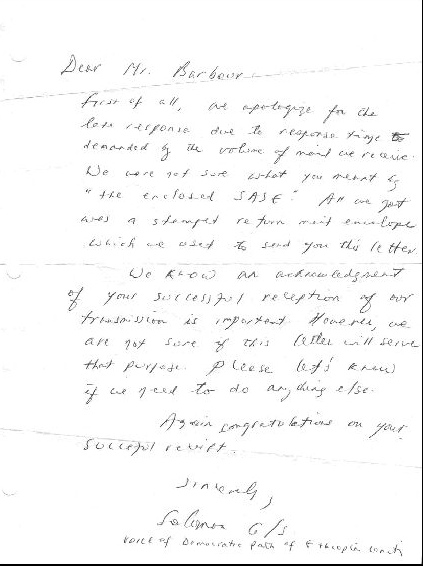
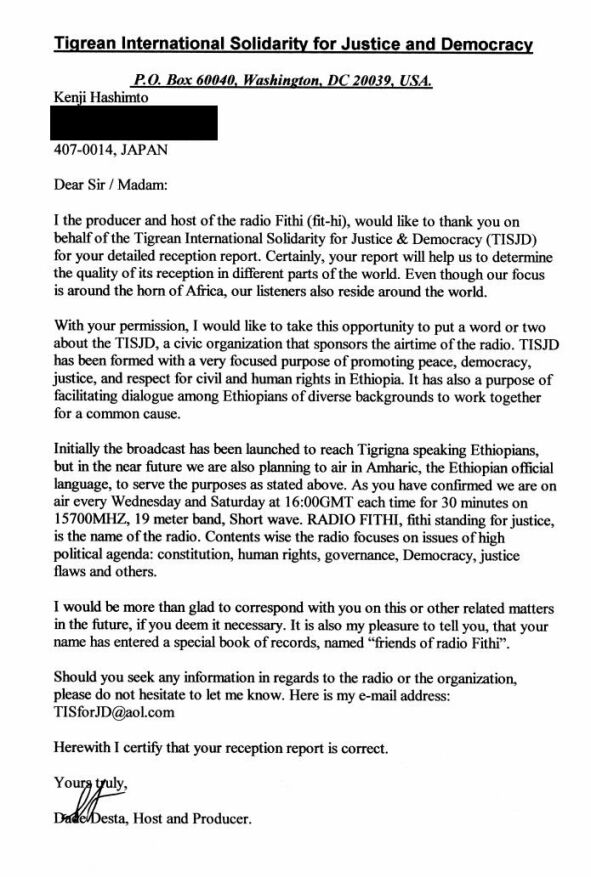
The 1980s and 1990s conflicts between Ethiopia and Eritrea caused the Horn of Africa region to become the focus of a bewildering range of clandestine radio activity. Before and after Eritrea’s 1993 independence from Ethiopia, dominant clandestine voices in Eritrea were the ‘Voice of the Broad Masses of Eritrea’ and ‘Voice of Democratic Eritrea’, whereas Ethiopia was inundated with the views of ‘Radio Rainbow’, ‘Radio Freedom’, ‘Voice of Oromo Liberation’, ‘Voice of Ethiopian Unity’, ‘Voice of the Democratic Path of Ethiopian Unity’, ‘Tigrean International Solidarity for Justice and Democracy’ and ‘Radio Fana’. Some of these stations are still on air today.


Across Africa, in the late 1990s and early 2000s Nigeria had three active clandestines, in the form of ‘Radio Kudirat International’, ‘Radio Nadeco’ and the ‘Voice of Biafra International’. The latter is currently still on air in English, heard recently on 7380 kHz at 2100 UTC.


Going back in time, a spate of clandestine stations sprang up in China in the wake of the 1966 Cultural Revolution. Although from different factions they shared an anti-Mao Zedong message. In 1967 several clandestine stations were thought to be based within China. Two went by the names of ‘Jiefangjun zhi Sheng’ (The Voice of the Liberation Army) and ‘Huohua‘ (Spark).

Some of them continued to broadcast even after the revolution ended 10 years later but had vanished by 1991. The identity of many of those behind the broadcasts still remains a mystery. There were a couple of notable exceptions however, with two stations identified as coming from, and being backed by, the Soviet Union.

In 1988 a Japanese DXer recognised the voice of an announcer at ‘Red Flag Broadcasting’ as the same announcer heard on the Chinese service of the U.S.S.R’s ‘Peace and Progress’ station. Independent research confirmed that ‘Radio 8.1’ originated from the Vladivostok region and that Red Flag Broadcasting Station was located near Khabarovsk.

In the wake of the 1989 Tianaman Square massacre a new station called the "Voice of Democracy Broadcasting Station" was heard daily on 8057 kHz but disappeared in 1991.

Current clandestines
There are many parts of the world in political turmoil and where oppressed voices are striving to be heard. How they are defined can depend on the individual’s viewpoint; Opposition groups, freedom fighters, guerrillas, terrorists, counter-revolutionaries…the definitions are controversial and a separate debate. However, current clandestines are predominantly heard today in Asia, the Middle East and parts of Africa.

Zimbabwe
If the definition of a clandestine station is that their operating base and transmitter sites are shrouded in secrecy then ‘SW Africa’ doesn’t quite fit the bill. Maybe it is a model of a 21st century, pro-democracy, opposition-in-exile clandestine station.

Since 2001 it has been broadcasting to Zimbabwe, as an independent voice of that country. It has been playing cat and mouse and being jammed by the authorities on shortwave and medium wave. It broadcasts news, current affairs, HIV education, phone-ins, music and helps put estranged Zimbabweans back in touch with each other. SW Africa can currently be heard in Southern Africa on 1197 KHz medium wave, and further afield on 6145 kHz. Also at: http://www.swradioafrica.com/

Other stations offering a alternative agenda from that of the Zimbabwean Government have included ‘Radio Truth’ in the mid 1980s, and’ Voice of the People’ (heard on 7120 and 7215 kHz at the turn of the century).

Burma
The Democratic Voice of Burma broadcast two hours daily radio broadcast to Burma on short wave, promoting press freedom, democracy and human rights. A variety of languages is used to spread their words as far as possible: Burmese, English, Arakan, Chin, Kachin, Karen, Karenni, Kayan, Mon and Shan. Times and frequencies are 1430 to 1530 on 17495 and 5905 kHz, and 2330 to 0030 UTC on 9435 kHz.

China and Falun Dafa Falun Gong (which translates as the ‘Great Law of the Dharma Wheel’) is a movement with Buddhist and Daoist origins that is banned in China. In the summer of 2000 they began Chinese-language radio broadcasts as a clandestine station called ‘World Falun Dafa Radio’. Their aims are to let ordinary Chinese know of the movement’s objectives and their persecution at the hands of the Chinese Government. With an estimated 50 million Chinese regularly tuning into shortwave radio stations, there is (almost literally) a captive audience. The opening broadcast translated as "Dear listeners and friends, greetings! World Falun Dafa Radio will officially begin broadcasting from today. The broadcast time is every evening 2200 to 2300 Beijing time [1400 to 1500 GMT] on the shortwave frequency of 9.915 MHz’. Falun Dafa operate clandestine television broadcasts as well as radio. The Chinese Embassy in the U.S.A claimed that in June 2002 signals from Falun Dafa cut into television signals on the Sino Satellite, blocking World Cup matches and 5th anniversary celebrations of Hong Kong’s return to China. BBC Monitoring reported that in November 2004 and March 2005, six transponders on the AsiaSat 3S satellite were also interrupted with programming carrying Falun Dafa content. Falun Dafa claim that they had nothing to do with the latter interruptions. They also state that China has killed more than 1,100 of their followers and sent 100,000 to labour camps.


Iraq

There are a plethora of clandestine radio stations operating to and out of Iraq at present. It is a confusing process trying to work out the politics and differences of each one. However whilst trying you can hear examples of many of them at Dave Kernick’s Interval Signals website: www.intervalsignals.net/countries/iraq.htm

Current and recent Iraqi clandestines include: ‘Radio Freedom the Voice of the Communist Party’, ‘Radio Kurdistan’ (both, unsurprisingly, in Kurdish), ‘Radio Mesopotamia’ in several languages including English, ‘Voice of Independence’, ’Voice of Iraqi Kurdistan’, ‘Voice of the Iraqi People’, ‘Voice of Iraqi Turkmen Radio’, ‘Voice of Kurdistan Toilers’, ‘Voice of the Mujahedin’ and ‘Voice of Rebellious Iraq’.


An example of how the U.S employed Psyops in the long running Iraqi crisis is the clandestine station ‘Radio Tikrit’. It came on air (on 1584 KHz) in early 2003, sounding as if it was a pro-regime Iraqi station broadcasting from Saddam Hussein’s home town. With it’s haranging of the USA and programmes such as ‘Open Dialogue’ they generally sang the praises of and supported the regime.


It soon transpired that this was not the case. Gradually Radio Tikirit slipped in news items on Iraqis so poverty-stricken they were selling doors and windows from their homes to buy food. This slowly built up into telling the Republican guard to desert and encouraging locals to turn against the Saddam regime.


It is widely accepted that Radio Tikrit was an American station, with programmes made by the 4th Psychological Operations Group broadcast from a CIA-controlled transmitter in Kuwait. Radio Netherlands commented that ‘The US is the only country which has a special unit of the Air Force permanently assigned to this task [Psyops]’.


Senegal
West Africa Democracy Radio (WADR) in Dakar, Senegal is a newcomer to the ever-changing clandestine scene. WADR is a pro-democracy and human rights radio station broadcasting on shortwave and 94.9 MHz FM since 14th November 2005. At the time of writing, BBC Monitoring and DXers report their schedule to be 0700 to 0800 UTC in English on 12000 kHz, followed by an hour of French on the same frequency. Programme content includes West African news and current affairs, youth programmes and music. They can also be heard online at: http://www.wadr.org/


Radio Rhino International Africa is run by the Uganda People's Congress. Based in Germany it aims to be ‘Your voice for freedom, liberty, democracy and an equally developed Africa’. It can be heard in English on 17870 KHz at 1500 to 1530 on Wednesdays and Fridays, transmitting from Juelich in Germany. Audio is also online at: http://www.radiorhino.org/


Many of these stations do offer QSL letters or cards, or e-mails, and are grateful for outside support and contact, so for the radio hobbyist there is an added bonus to monitoring them. As areas of conflict change the some stations fade away and new ones spring up. At the time of writing the Ethiopian/Eritrian border looks a likely hotspot. For instance Voice of Oromo Liberation in the Oromo language from 1700-1800 on 9820 kHz, Voice of the Democratic Path to Ethiopian Unity in Amharic from1900 to 2000 UTC on 9620 kHz and the Voice of Democratic Alliance, Eritrea on 7165.13 kHz at 1500 UTC.


Times and frequencies are liable to change without notice, such is the nature of undercover broadcasting. They are unlikely to adhere to the domestic and international regulations governing mainstream broadcasters. To listen in yourself you can spin the dial in hope or use a more methodical system, such as the excellent online schedule compiled by Eike Bierwirth at: www.schoechi.de/crw/bierwirth.html


There are of course, many more stations currently broadcasting that have not been touched upon here. Radio Free Southern Cameroons (12130 kHz, 1800 in English) Minivan Radio in the Maldives, Que Huong Radio in Vietnam, The Polisario Front's National Radio of the Arab-Saharan Democratic Republic in Western Sahara, Sea Breeze, or Shiokaze, in North Korea, Radio Nile, and the Voice of Jammu-Kashmir Freedom in Kashmir. Keeping an eye on websites such as Clandestine Radio Watch keep you up to date with the latest information: http://www.schoechi.de/


So what of the future for clandestine radio? Clandestine radio has been around almost for as long as radio itself. And there will always be communities with a grievance who use clandestine radio as a means of getting their voices heard, educating people or attempting to overthrow undemocratic regimes. With the accessibility of the Internet increasing, clandestine stations can also use the web as an additional means of promulgating their opinion.

However, the majority of the intended audiences are in parts of the world where often water and electricity are in short supply, let alone computers. The simple means of radio transmissions will remain the best way to get messages to the masses.

There is a world of difference in listener feedback as well. In the western world a measure of a successful radio station is from listeners’ e-mails, text messages or letters. In areas of the world where a clandestine station is operating, success can be measured by a far more fundamental yardstick; an uprising or overthrowing of a government.

For the experienced DXer clandestine radio is a fascinating and lesser-explored aspect of the hobby; for the clandestine broadcaster and intended recipients it can be a matter of life or death.


Resources and further reading
DX Zone: http://www.dxzone.com/
Radio Netherlands: www2.rnw.nl/rnw/en
Chinese clandestine stations: www.246.ne.jp/~abi/chiclae1.htm
Clandestine Radio: http://www.clandestineradio.com/
Clandestine Radio Watch (Martin Schoech): http://www.schoechi.de/
Current Clandestine schedules (Eike Bierwirth): www.schoechi.de/crw/bierwirth.html
Clandestine Radio Broadcasting: A Study of Revolutionary and Counterrevolutionary Electronic Communication by LC Soley and JC Nichols, Praeger Publishers, 1986
Don Moore: www.swl.net/patepluma/central/cuba/rebel1.html
DX Listening Digest: http://www.worldofradio.com/
Monitoring Times 4/1989, Revolution! Radio's Role in the Overthrow of Guatemala,
Psywar Org: http://www.psywar.org/
World DX Club Contact magazineWorld Falun Dafa Radio: http://www.falundafaradio.org/

August 2007 Radio Websites


Published in full in Radio User, PWP Ltd, August 2007


If you want to get away from it all this summer, and are interested in radio, you could do worse than stay in the old Decca building in Lerwick, on the Shetland Isles. It was previously accommodation for Shetland’s Radio Navigational Signal Station and its operators. Now tastefully converted to three two bedroom flats: www.selfcateringshetland.com/properties

Whilst there you will hear the following on the radio dial. Of course you can always listen online instead! BBC Shetland is at: http://www.bbc.co.uk/scotland/radioscotland/programmes/shetland& You have to be on the ball to listen live though, as this is just a thirty minute show each Friday at 1730 BST. Good Evening Shetland contains local news and weather, diary, jobspot, the fish report and 'Clear da Air'.

The BBC opened Bressay transmitting station in Shetland was back in 1964, and there is a fascinating illustrated account at part of the MDS975 website: http://www.arar93.dsl.pipex.com/mds975/masts/bressay/bressay.html

Shetland Islands Broadcasting Company. On air 24 hours a day on 96.2 MHz, unfortunately its format is nothing inspiring, consisting of the usual bland pop formats so beloved of 99% of local radio stations throughout the western world. The most intriguing part of the programming is the news covering ‘local, maritime, fishing and oil.’: http://www.sibc.co.uk/

RTE (Radio Telifis Eireann) is experimenting with DAB Digital radio. Six new stations will be trialled until November, and can be heard if you live in the Greater Dublin and north-east coastal area. The stations are RTÉ Junior (pop radio for children from two to teens as well as for young parents); RTÉ Gold (classic hits); RTÉ Digital Radio News, (a rolling news bulletin station); RTÉ 2XM ( for students and young adults, specialising in playing new music first); RTÉ Digital Radio Sport; and RTÉ Choice (comedy, documentaries, vintage shows, music, international programming). See: www.rte.ie/digitalradio/

You can also listen to the new DAB station identifications at: www.rte.ie/digitalradio/idents.html

A website opened up in May at the commencement of an Irish body covering Digital Radio in the country: www.digitalradio.ie/
Finally there is a discussion group on the subject based at: www.boards.ie/vbulletin/showthread.php?t=125569

Fifty summers of Test Match Special
http://news.bbc.co.uk/sport1/hi/cricket/tms/default.stm

General Overseas Service of All India Radio: http://www.allindiaradio.org/external.html and http://www.allindiaradio.org/index.html

Caribbean Broadcasting Union (CBU) and the Caribbean News Agency (CANA): http://www.cananews.net/
‘Caribbean Radio on the Net’ site at: http://www.caribbeannews.com/radio.html

A selection of stations from Anguilla to the Virgin Islands are included. Here are some of my recommendations: Radio Ginen in Haiti http://www.radyoginen.com/, Radio Guyana: http://www.megajams.com/ includes music 24/7 and cricket. The Caribbean Broadcasting Company is at: www.cbcbarbados.bb/ and offers stations The One 98.1, Radio 900 and Quality 100.7. All of these can be heard online.

Friday, 6 July 2007

Pictures on the radio, some quotes


Some quotes; some are so true with a whiff of nostalgia, others are words of painful truth in a mad world


A whiff of nostalgia
"It's not true I had nothing on, I had the radio on." - Marilyn Monroe

“The whole country was tied together by radio. We all experienced the same heroes and comedians and singers. They were giants.”- Woody Allen

“People in America, when listening to radio, like to lean forward. People in Britain like to lean back.” – Alistair Cooke

“When television came roaring in after the war (World War II) they did a little school survey asking children which they preferred and why - television or radio. And there was this 7-year-old boy who said he preferred radio "because the pictures were better."

“A bunch of friends going to a match and talking about it." -Brian Johnston on why Test Match Special works. The friend in the next imaginary deckchair is the listener.


Hear hear

“Yes, I always feel that the music I like, and I genuinely like, the stuff I play on the radio is my own way of going out on the street and righting these wrongs that I think should be righted”. – John Peel

“Radio is the theater of the mind; television is the theater of the mindless” – Steve Allen

“Radio news is bearable. This is due to the fact that while the news is being broadcast, the disk jockey is not allowed to talk.”- Fran Lebowitz

“I am amazed at radio DJ's today. I am firmly convinced that AM on my radio stands for Absolute Moron. I will not begin to tell you what FM stands for.” - Jasper Carrott

“European imperialism long ago made Tahiti a distant suburb of Paris, the missionaries made it a suburb of Christ's kingdom, and the radio made it a suburb of Los Angeles”- Cedric Belrage

“The party of Lincoln and Liberty was transmogrified into the party of hairy-backed swamp developers and corporate shills, faith-based economists, fundamentalist bullies with Bibles, Christians of convenience, freelance racists, misanthropic frat boys, shrieking midgets of AM radio, tax cheats, nihilists in golf pants, brownshirts in pinstripes, sweatshop tycoons, hacks, fakirs, aggressive dorks, Lamborghini libertarians, people who believe Neil Armstrong's moonwalk was filmed in Roswell, New Mexico, little honkers out to diminish the rest of us, Newt's evil spawn and their Etch-A-Sketch president, a dull and rigid man suspicious of the free flow of information and of secular institutions, whose philosophy is a jumble of badly sutured body parts trying to walk.” – Garrison Keillor


Wednesday, 4 July 2007

Of Spies and Men

FROM THE ARCHIVES:


Chrissy Brand reports from the 2003 Defence Electronics History Society symposium,
on what were once highly classified spy radio operations

First published in Radio Active, PWP, 2004

The DEHS (Defence Electronics History Society) was set up to document and preserve the experiences of defence electronics research, development and applications. The society has around 200 members, and collaborates with a dedicated research unit at Bournemouth University, OHRU (Oral History Research Unit). It is appropriately located in Bournemouth due to the many defence electronics activities in the Hampshire and Dorset region since the 1930s.


You might ask why the history of defence electronics matters, to which the DEHS would say that many of the rapid major advances in science and technology have resulted from the pressure to meet military and defence needs. World War II acted as a catalyst, rapidly increasing the rate of innovation and development in electronics. This in turn laid the foundations for many applications of electronics in both civilian and domestic life, including computing, air traffic control, marine navigation, satellite communication, weather forecasting, medical equipment, radio astronomy and even microwave ovens.

Clandestine radio
The DEHS holds an annual symposium for members and non-members alike. Previous topics have included naval electronics, air defence, and military communications to name but three. The 2003 symposium was entitled Clandestine Radio, or what we in the broadcast radio world would probably call spy or espionage radio. Whatever the definition, the symposium was a day packed full of wondrous stories, revelations and tales of bravado. The meeting concentrated on some of the receiver– transmitter radio sets used by undercover agents and monitors in Europe from World War II to the end of the Cold War. These agents transmitted and received messages by morse code and by the use of encrypted messages, such as one time pads. Whilst resistance members and intelligence services agents went about their cloak and dagger business, monitoring stations were staffed by equally secret teams receiving and decoding the messages, as well as those trying to intercepting and trying to decode enemy transmissions.

Polish Clandestine Radio in World War II
Sebastian Siemasko was in the Polish military, and recounted how Polish clandestine radios were manufactured and operated during World War II. In 1939 the Polish Government’s second department of the Polish GHQ asked the company ABA to produce a small clandestine transmitter-receiver for Polish secret agents in Europe. They produced the Peepshtock set, similar to the German Enigma machine.

When the invading Germans took over ABA’s premises in Warsaw, a signal assistant managed to smuggle out a Peepschtock set and some spare parts. By 1940 there was a Polish army workshop in Stanmore, Middlesex, producing sets (about 150 by 1942). There were four huts where the Polish Military Research team worked, with personnel increasing to 9 officers and 43 on the production line by 1943, when 540 sets were produced. The A1, A2 and A3 sets were superseded by the AP3, AP4 and AP5. These were crystal controlled five microvolt transmitter-receivers, measuring 225 x 190 x 95mm.

Trials had been carried out on Polish, American and British sets, with the Polish version coming out on top. This was due as much for packing as performance, with it resembling a tradesman’s metal toolbox, whereas other sets came in suitcases, making them unsuitable for use in countries under German occupation. In the second half of 1944 a total of 402 transmitter-receivers were parachuted into Poland for undercover agents, along with a further 277 receivers and hand generators. Out of 214 Peepschtock sets dropped, 44 were damaged upon landing.

In addition to the 920 Peepschtock sets another Polish clandestine receiver was produced in the UK. This was the OP3, measuring 175 x 125 x 40 mm. A non-clandestine receiver, (the BP set) planned for use after World War II was also made.


German Clandestine Radio in World War II
Arthur Bauer gave a presentation on German clandestine radio sets, many of which were designed by Rudolf Staritz. He spoke of the wireless service receiving stations in the forest at Belzig to the west of Berlin and in Wohldorf, north of Hamburg. A number of radio receivers were used, including American Skyriders, Hallicrafters, Superpros, as well as a Siemens model made especially for intelligence operations.

High-powered models concealed in suitcases were used by German and Axis intelligence. The S89/80 had 80 watt antenna power and reception up to 25 MHz. This long distance model was used in South Africa and South America, and many were dumped at sea towards the end of the war.

The 40 watt SE90/40 mains powered suitcase set was widely used in Europe, and a three watt battery set SE92/3 with a less conspicuous canvas cover was used on both the western front and in the Russian theatre. Agents were dropped with these small, compact sets complete with a pack of batteries that could last for one year, if used for 15 minutes a day.

Another model in a seemingly never-ending range of ingenuity was the attaché case station type SE98/3. Attaché or briefcases could also contain sheaves of paper to help conceal the set further.

In 1943 a ten watt SE99/10 receiver was produced, in the guise of a cigar box. Transmitter-receivers such as the ten watt SE108/10 were very compact and had a morse key to tap for transmitting. This miniaturisation continued with the pocket sized battery operated E 108/3.

On the receiving side, German equipment made rapid advances, and could trace local transmissions from allies or enemy agents. Tracking equipment worn under a trench-coat, with an antenna around the neck and a field strength meter as a wristwatch enabled Germans to trace clandestine signals on foot.


Once it had been working out the approximate area that the transmission was coming from, the Germans could pull the electrical supply in the area block by block, and when the transmission signal cut off, it was obvious which block it was coming from. A way to counteract this was for agents to switch to battery power should the lights go out.


Dutch amateur radio operators had to give up their equipment under German occupation, but one Dutch ham (PAOYF) in the Hague continued to operate, using a Portuguese call sign (CT1LX). His transmissions were picked up by a DF unit in Kiev and he was captured, but survived the concentration camp he was detained in.


The Romney Marsh Clandestine collection
John Elgar-Whinney has amassed a large collection of spy radios from the Second World War to the 1970s. He enthralled the audience by demonstrating many of them, and invited people to partake in a hands-on session.

A wide range of sets, displaying technical expertise and cunning, included the Polish AP3 Housebrick model, a pocket-sized set, with a battery of similar size and lightweight headphones. The British Biscuit receiver came in a Huntley and Palmer biscuit tin, with two battery packs, a power pack, and headphones mounted on card.

The famous German Enigma machines were called Geheim-Schreiber (Secret Writer) in German. Before World War II some Enigma machines were manufactured in Poland and smuggled out. Although the most famous of the coding machines, they certainly now look the most cumbersome and outdated.

The S Phone was a lightweight guidance beacon used when agents were dropped. It was fitted with a special army mouthpiece transmitter for privacy. Even someone standing next to an S Phone operator would be unable to hear them speaking.

Equally fascinating were the World War II transmitter-receivers designed for use by Allied prisoners of war. M19 developed a super miniature radio receiver to conceal in Red Cross food and book parcels which were sent to POWs. Also sent were some sub-miniature transmitters to identify the location of POW camps.

John Elgar-Whinney pointed out how in the 1940s the ‘average British radio and speakers (used in the home) were almost large enough to crawl into and live.’ The miniaturisation techniques used for intelligence and POW receivers were far ahead of their time.

One of the first, in 1942-43 was the size of an audio-cassette case, operating off two SP11 batteries. It had a fixed frequency and two tuning knobs, and was disguised in a game. Another was the 1943 cigar receiver, so called as it was the size of a cigar box. It had no need for an aerial or earth, as the capacitance of the operator’s body acted as an aerial when holding it.

The vogue for disguising equipment continued, with the Sweetheart receiver being produced by the Norwegian resistance network radio engineers, replicating a ladies vanity case.

The British model 328 Embassy receiver was also known as the Tupperware receiver, as it was disguised in a Tupperware box, very much placing it in the era of the 1960s and 1970s. Something that you would not have been offered at suburban Tupperware-selling parties in the 1970s! It was used by Embassies to decode messages and record diplomatic coded messages via a Uher 4000 tape recorder. It was fully transistorised to work on an internal 11V battery or 12V external battery. The receiver was sensitive enough to receive signals worldwide using only a whip aerial.


The KGB and Colonel William Fisher
Vin Arthey gave an appetiser of his forthcoming book on the KGB’s most celebrated radio man, William Fisher. His father was a Russo-German exiled by the Tsar in 1901, and William was born in Newcastle upon Tyne two years later.

Willie Fisher joined the Komosols in Moscow in 1922. A keen radio ham since a boy, his search for crystals for radios saw him procuring them from the mountains and geology collections. When called into the Red Army in 1925 he served in the radio battalion and was trained as part of the Russian radio elite.

A week after his marriage in 1927 he joined the KGB, and was sent on his first mission to western Europe in 1931, accompanied by his wife and daughter, where he ran a KGB training school. One of the students was Kitty Harris, also known as the spy with 17 names. He became a radio operator for illegal Soviet residents, setting up receivers and transmitters in attics, as well as receiving messages and dead letter drops.

Sacked in 1938’s Great Purge, he was reinstated three years later, and was the radio operator on the steps of Lenin’s mausoleum during the Red Square October Revolution celebrations. Also during World War II he was part of a radio deception, details of which are still classified, which involved deceiving the Germans into sending a large amount of equipment and supplies to what was a fictional army.

His post-war career as secret agent continued in the USA, where his cover was as a retired photographer and amateur artist. He received messages for the Cohens and Rosenbergs and was the KGB’s USA paymaster. Indeed, he helped get Cohen out of the USA just as the CIA were closing in on him.

He prepared for what was termed the ‘special period’, when Moscow expected the cold war to evolve into a hot war. His role included hiding radio transmitters throughout the USA (although none have been found), and preparing escape routes into Canada for fellow east and west coast saboteurs and agents.

In early 1956 he was betrayed by a fellow KGB agent in New York, and his Hallicrafter receiver was found. However, he gave nothing away to his FBI interrogators, who remarked that he ‘spoke kinda funny’. This was in fact his Geordie accent. He was jailed and later exchanged for Francis Gary Powers in 1962. (Powers was shot down over Soviet territory in 1960, taking photos of military installations for the CIA).

Back in Moscow he worked in the Lubyanka (KGB HQ), but because of his life in the west, and the paranoia and suspicion that goes with the career of secret agents, he was never fully trusted again. Despite this, and no longer being an operational spy, he was still revered as a great hero. He went under the name of Rudolph Abel (the name of his best friend that he gave to the Americans in 1956) until his death in 1971.

The hundredth anniversary of his birth (in north-east England) was commemorated by a group of die-hard communists in a Moscow cemetery last summer.

Radio Surveillance in Modern Times
This section (and photos) was removed for security reasons on the request of a UK communications company...
...However, the following may be of interest, from PHP (The Parallel History Project Dec 10th 2004, Anna Locher and Christian Nuenlist Center for Security Studies at ETH Zurich
NEW DOCUMENT COLLECTION: SECRET WARFARE: OPERATION GLADIO AND NATO'S STAY-BEHIND ARMIES

As has become publicly known since 1990, stay-behind armies covered all of Western Europe and operated under different code names, such as Gladio in Italy, Absalon in Denmark, P26 in Switzerland, ROC in Norway, I&O in the Netherlands, and SDRA8 in Belgium. The so-called Allied Clandestine Committee (ACC) and the Clandestine Planning Committee (CPC), linked to NATO's Supreme Headquarters Allied Powers Europe (SHAPE), coordinated the stay-behind networks on an international level. These armies served the dual purpose during the Cold War - preparing for a communist Soviet invasion and occupation of Western Europe, and for an "emergency situation". Learn more about the matter in the introduction by Daniele Ganser, Senior Researcher at the Center for Security Studies at ETH Zurich, at
http://www.isn.ethz.ch/php/collections/coll_gladio.htm


Conclusion
Overall the day gave a memorable insight into an undercover world of espionage activity, revealing what were once top-secret operations. As well as the gripping presentations, it was a rare privilege to examine some of the secret agent equipment, all of which was the cutting edge of its time. For all the documentaries and books that cover the murky world of espionage and counter intelligence, there is nothing like the experience of actually playing around with the wheels and cogs of an Enigma machine, or trying the headphones of a suitcase receiver for size.

World War II and Spy films such as The Heroes of Telemark, Enigma, Orson Welles’ the Third Man, and James Bond have given us a glorified glimpse into a secretive world. However, it is something else to be surrounded by the real thing. Merely by holding the controls, you can feel history throbbing through your veins, trying to come to terms with how a real life operator of such equipment might have felt, every second an untold danger, every transmission a possible matter of life and death.


Further reading
The DEHS President is Dr Bill Penley CBE, who has assembled material from scientists involved in the early work on radar. More details can be found by consulting the online Penley Radar Archives at: http://www.penleyarchives.org.uk/

OHRU (Oral History Research Unit) at Bournemouth University. The focus of the University based research activity is personal recollections of those involved with the invention, development, production, operational use and maintenance of land, sea and air based electronic equipment and systems. So far work has mostly concentrated on radar and radio communications during World War II. http://histru.bournemouth.ac.uk/CHiDE/CHiDE.htm

Vincent Arthey’s, Like Father, like Son a biography of Willi Fisher, published in 2004 by St Ermin's Press. St Ermin's is a small press specialising in espionage material, which markets its titles through Time Warner.

There are many books that mention covert wireless activities, especially those of the Second World War. We will have to wait a few more years for stories from the agents of the cold war and the current period. Two BBC television series and books that covered the Special Operations Executive (SOE) have sections on communications. SOE 1940-1946 by MRD Foot (1984) and Secret Agent (The true story of the SOE) by David Stafford (2000).


Two historical scenarios ~


1) Northern France, Autumn 1943


Post graduate student and covert wireless operator Pierre Duval reaches the edge of town. He wanders across a frozen ploughed field to the edge of the copse where yesterday he was chopping logs. Discreetly checking that the road behind him is clear, he disappears into the wood. Sheltering within he takes out his transmitter-receiver secreted within his coat. He quickly unpacks and with numb fingers starts to tap on the morse key. Later that afternoon the information that his resistance group has successfully cut enemy telegraphic installations and awaits details of the next supply drop, is received at HQ somewhere in the English countryside.


2) Vienna, Summer 1957


Veronica Smethurst, a secretary for the United Nations in the Austrian capital, returns to her second floor apartment on Josephplatz. The cigarette smoke, expensive perfume and polite conversation of the evening’s drinks party at the American Embassy still lingering, she removes her stilettos, and still in her cocktail dress sits down at her dressing table. Opening a draw she takes out a vanity case. which once unzipped, reveals a small transmiiter- receiver.

She checks the time and tunes in around the 41 metre band. Soon, after a familiar prelude tune, a series of numbers are announced through the airwaves. She writes them down, straining to hear through the crackle and hiss of the ether. They are repeated several times, and after 20 minutes, Veronica is satisfied that she has transcribed them correctly. She puts away her set and is awake until the small hours decoding the message. Does it prove to be routine dummy traffic, or does it contain details of the next dead letter drop?

Saturday, 30 June 2007

Radio Websites, (as seen in Radio User July '07)


These are edited extracts from July 2007's Radio Websites in PWP's Radio User magazine.

As well as all the thousands of radio station websites to browse, there are countless websites set up by enthusiasts and listeners, many of which post entertaining and useful background information on the hobby. I thought I’d dip into a variety of these this month. Don’t forget, if you have a website of your own you want to share with readers, or one that provides a useful service, just drop me an e-mail at: chrissy@sutton-brand.freeserve.co.uk

Yoga by radio
A strange title with which to commence this month, but all will be revealed, as we go to a long-established website: Mike Brooker’s DX Dharma...Based in Toronto, there are also plenty of fascinating facts on his trips to India, including an India DX logbook. Dharma being ‘right conduct, righteousness, or devotion according to the practice of Yoga and the Hindu or Buddhist scriptures.’ As Mike writes, it is ‘not a word you are likely to hear on any shortwave broadcaster, except perhaps All India Radio.’ : http://webhome.idirect.com/~aum108/dx.html

Yoga by Radio is not as strange a concept as it might first seem. You can hear some inspirational meditation sounds at: http://heartspring.net/meditation_music.html

This includes links to Soma FM. There is a website celebrating 275 years of Sahaja yoga meditation in Australia, which includes online yoga radio broadcasts from Sydney at: http://www.sahajayoga.com.au/level_1/Radio%20links.shtml

And don’t forget Yoga Spirit radio at: http://www.yogaspirit.ca/
and specifically http://www.yogaspirit.ca/radio_main_list.php

Those who choose to enthuse

The Shortwave Report is a 30 minute review of news stories recorded, unsurprisingly, off of a shortwave radio: http://www.outfarpress.com/outfarpress/shortwave.shtml

Radiolicious is a great name and an equally good blog at: http://www.radiolicious.co.uk/

It also has an equally fascinating sister site that covers radio in Berlin: www.radiolicious.co.uk/berlin

Advance warning of Euro Radio Day 2007, which takes place in Calais, France on Saturday 8th September: http://www.offshoreechos.com/


Finally, I was delighted to see that the wonderfully witty BlanDX is back, with an online version: http://www.blandx.com/ This was a paper publication a decade or more ago which wickedly parodied the quirky world of DXing. It is now the most humorous radio website I have ever seen. With laugh out loud features such as spoof logs, QSL cards and adverts, the DX Squabble, Uncle Harold's Guide to DXPedition Etiquette and a wonderful strip cartoon called The Radio Family. Read them and weep with laughter at: http://www.blandx.com/trf/theradiofamily.html

Monday, 11 June 2007

Off the beaten track, the world of sport on radio

FROM THE ARCHIVES:
Photo 2004 Olympics, by Alison James
 
Article first published in Radio Active January 2005
By Chrissy Brand

If your view on sport on the radio is that of a hoarse, partisan reporter crackling down a telephone line on your local FM station, it's time to think again. Listening to sport on mediumwave, shortwave or satellite radio, be it in English or other languages, can be a richer, more varied and overall far more exciting experience.

Although BBC and commercial radio coverage of sporting events is good, why not be adventurous and re-tune the radio to hear things from a different perspective. You might discover an exciting new sport to follow or be amazed at the delivery methods of the commentators. At the very least you will learn some sporting trivia to impress your friends with!

This article will cover different sports from many continents. Along with global favourites such as football and athletics, there will be a peek into some of the lesser-known games. Armed with a basic radio, pen and paper you will soon be able to experience the world of sport for yourself. I sat down the other weekend and in no time at all found myself hooked on the Cork City against Bohemians match on RTE 1. I then heard football reports and commentary in Dutch on Belgian station VRT1 (927 kHz) with mention of ‘You’ll Never Walk Alone’. On longwave Europe 1 (183 kHz) and Radio Monte Carlo (216 kHz) had French football, with what I assumed was the Luxembourg league covered on RTL on 234 kHz.

Flicking over to short wave there was a choice of two top Spanish matches. RNE (Radio Nacional de Espana) carried the Deportivo de la Coruna game on 9630 kHz (also heard on 585 kHz medium wave). The Barcelona against Real Madrid match was also broadcast by RNE on 9665 kHz. So I really was spoilt for choice.


UK RSLs
Time to kick-off in the UK with the Restricted Licence Services (RSLs). As you may know these are licences granted by Ofcom for low powered radio stations to cover a local community or religious event. Stations pay a fee and are restricted to between 1 and 24 Watts for FM and 1 Watt for AM. Frequencies allocated are usually 87.7 mHz on FM, then there are several on mw including; 1494, 1503, and 1602 kHz.

Sporting events of course lend themselves to RSLs. It’s an ideal set up; a low power radio station within a stadium, broadcasting to an audience on a common and popular topic. Horse racing festivals such as Ascot and Cheltenham or race-days at other courses like York (on 1602 kHz), are popular for RSLs. Usually you can hear the station within ten miles of the venue, so on the way to the ground you will get useful traffic and car parking information. Build-up features such as the latest betting odds, interviews with owners and riders, expert predictions and ground conditions are standard programme content. As the station is dedicated to the one event you can hear detailed coverage that other national and local stations cannot really compete with, as they have to juggle several different sports at the same time.

2004 saw many varied sporting RSLs, many of which will be on the air again in 2005, so listen out for motor racing events at Castle Donington and Silverstone (1602 kHz), Radio Wimbledon (87.7 mHz), match play golf from Virginia Water (107.3 mHz), yachting regattas at Argyll and Dartmouth, speedway from Rockingham, horse racing from Goodwood and Epsom and motor racing on Radio Oulton in Cheshire.

There are currently six sporting RSLs in operation on a regular basis. Rather than covering an annual event such as a British Grand Prix, these are mostly RSLs for individual football clubs, who are allowed to broadcast on every home match. You can certainly expect plenty of bias towards the home team. If you thought local radio was passionate, you should hear some of these guys. As you might expect, Manchester Utd are one of them, and they also have a television station, MUTV, which started in 1997. Manchester Utd radio has broadcast from all home games as an RSL station on 1458 kHz for several seasons.

However, Blackburn Rovers were the first football club to operate an RSL station, back in 1993, and Radio Rovers can still be heard in and around Ewood Park on 1404 KHz. Across the Pennines Barnsley FC have Oakwell Radio 1575, whilst Palace Radio (1278 kHz) are enjoying life in the Premiership with Crystal Palace.

Southampton football club have gone one step further and last Spring became the first football club to own a full-time FM radio station. The station broadcasts 24 hours a day on 107.8 FM , Sky digital 899 and locally on DAB.

Also currently on air are RSLs Big Blue 96.3 (London), and Ref!Link. Ref!link is a service for Rugby Union matches, enabling fans to hear what the referees is saying, and why he has taken certain decision. It has been used at Twickenham and at home game for London Irish and Leicester Tigers. It is part of a brand called Sports!Link FM, which has provided unique live commentary to spectators watching superbikes, sailing, motorsports, cricket, eventing, dressage, tennis and golf.
Sports!Link produce some nice products to hear their services on, from a disposable receiver that lasts three days to an all-season version. They also make a product aimed for motor sports and horseracing spectators which has an FM radio housed in a pair of x8 sports binoculars.


Away from RSLs, but on DAB, Freeview and shortwave, BBC World Service has some fantastic sports coverage from a truly global perspective, with for instance, all the major South American football results. Sportsworld, Sports International, Alan Green’s World Football and Sports Round up are amongst the programmes to listen out for. Check the Radio Times for details.

Before we leave Britain I have to mention the sport of ‘Rasus’, or harness racing. It looks like something from Ben Hur, and its origins are indeed 2000 years ago in Roman times. There are race-tracks around the UK, and Welsh television channel S4C has coverage. The jockeys sit back in their carriages and race the horses around at speeds of up to 30 m.p.h.

Europe
Just tuning your dial around medium and shortwave you will hear powerful signals beamed from many European countries, not necessarily aimed at the UK, but still providing a very clear signal. With just a little bit of research you can soon tune into sporting events all over Europe.

Ireland’s Radio Telefis Eireann (RTE) Radio One broadcast in English and can be heard across the UK, on 567 kHz mw and 252 kHz longwave. Two unique sports that have a large share of coverage and are a major part of Irish sporting tradition are Gaelic Football and Hurling. Gaelic football predates soccer and rugby and is a mixture of the two. It is 15 a side with a round ball which can be carried, kicked or propelled into or over the goal to score points. Hurling has some similarities to hockey and is Europe’s oldest field sport, going back 2000 years to Celtic times. ‘The Championship’ is a regular RTE programme covering all aspects of Hurling and Gaelic Football.

‘Sports Call’ is a Monday evening phone-in programme with Des Cahill. Weekends have three main sporting shows, ‘Sportsnight’ on Friday, then Saturday and Sunday Sport. There is plenty of good local sports coverage which includes horse racing and rugby union. Football is covered further with additional programmes such as a series on ‘Irelands Soccer Top 20’, which profiled Irish legends.

To try some foreign sounds, football matches on Radio Difusao do Portugal (RDP) are worth listening to for the excitable commentators, even if you don’t understand Portuguese. Try 13720 kHz from 2100 UTC. You can work out who is playing as team names are always mentioned in the commentary. Many UK newspapers publish fixture lists of major domestic league and European matches for the following week which also gives you a clue.

Radio National de Espana (RNE), like its Iberian neighbour, is passionate about football. It is very easy to hear the RNE and COPE networks booming in on medium wave in the evenings. Goals are announced on air by a jingle along with excited screams of ‘gol, gol, gol, gol GOL!!!’ from the commentator and his side-kick.

In Scandinavia, the Finnish state broadcaster often carries coverage of the many wintertime sports beloved by many Nordic inhabitants. Finnish is a strange but distinctive language to our ears, and you soon realise when you are hearing a cross country ski race on YLE radio. Listen for the background shouts from the crowd with klaxons and bells as skiers race downhill, through slaloms, into the air or through the forests. It makes for entertaining radio in any language. Coverage of ice-hockey competitions such as the International Karjala Cup will also be mentioned. Try 11755 and 9705 kHz from the Pori transmitter from 0600 to 1900 until the evenings. On mediumwave 963 kHz can be picked up as well.

There are many major professional winter sports events held throughout Scandinavia, and some for amateur enthusaists too, such as the Lahti Ski Club’s 60 km and 30 km classic races, from Lahti to Hollola and back.

Dave Russell of Radio Sweden presents ‘SportScan’ on the first Wednesday of each month, which covers all sports from a Swedish perspective. Successful Swedish lady golfers, tennis, ice hockey, skiing, table tennis and soccer are all regulars.

Even Vatican Radio’s Italian service has time for mention of sporting achievements. After all, Pope John Paul II used to be a goalkeeper. In a weekly programme hosted by Luca Collodi, Cardinals double up as football commentators. This is heard on Vatican Radio's One-0-Five Live and director Sean- Patrick Lovett states: "It' s a man of God talking sports, an earthly pastime, talking the people's language. Sports is something that the people are interested in. The church is not just about sex scandals and papal decrees."

Radio Prague has regular sports bulletins in English, so you can hear the exploits of Czech teenage tennis player Berdych, leading Czech racing driver Tomas Enge competing on the Indy Racing League, and new rally driving sensation Jan Kopecky. The annual Velka Kunraticka cross country race, recently held in Prague's Kuntraticky Forest attracts many older runners and has an over 70s category as well.

You can soon gain an interest in the international and national ice hockey too, which is a big sport in the Czech Republic. If you want to pick a team to follow, how about Pardubice, who have been winning well and have some North American NHL stars in their team (Jan Bulis and Milan Hejduk). Sport crops up in the daily 30 minute programmes, try 1800 UTC on 5030 kHz.

Deutsche Welle in Berlin brings you ‘Sports Report’ at five minutes past the hour throughout Saturday and Sundays. German athletes, footballers and skiers are all featured. And if you want to follow the German Bundesliga more closely, you can try their fantasy football-like ‘Tip for the Top’ webpage, and predict scores. Can surprise early leaders Vfl Wolfsburg continue their form throughout the season?: http://bundesligatip.dw-world.de/english.do


The Americas
The American Forces Network (AFN) has been broadcasting to troops in Europe for 60 years, and it is easy enough to tune to. They use 30 radio transmitters located throughout Europe mostly carrying FM frequencies, but try evenings on 873 kHz mw from Frankfurt.

If you are a fan of any of the traditional North American sports such as baseball, basketball, ice hockey of American football you can be transported from your armchair to the live action. Listen in to matches on AFN like the Portland Pirates versus St John’s Maple or the Red Sox versus the Maples. Weekdays at 1635 UTC there is a 25 minutes sports programme called ‘Sports Byline’. Weekend mornings has ‘Sports Overnight America’, and there is often coverage of a major game from 1900 UTC at weekends as well.

Radio Canada International includes sports news in ‘Canada Today’ programme. Ice hockey is a fast and furious national obsession and the Canadians are current world champions. Tune in on short wave to get the National Hockey league latest and news of other Canadian athletes and sporting superstars. (2100 UTC on 5850 and 9770 kHz).

Also on shortwave Cuba has a regular round up of sports on the English service of Radio Havana. It isn’t that easy to hear but one frequency to listen on is 9550 kHz at 2345 UTC. Whilst we are on difficult to receive signals, you might try for some transatlantic medium wave DX. There are a number of North American east coast sports radio stations that can be heard in the U.K. If you listen between 2100 and 0630 UTC you might strike lucky. WFAN and WEPN in New York on 660 and 1050 kHz, WEEI and WWZN in Boston on 850 kHz and 1510 kHz, WJAE in Portland on 1440 kHz and CJYQ in St Johns, Newfoundland on 930 kHz.

Africa and Asia
The Voice of Nigeria broadcasts to Europe in the mornings and evenings on 15150 kHz, and include a ‘Sports Round Up’ programme. In South Africa international broadcaster Channel Africa has some sports-specific programmes, and covers results in the general news service from Johannesburg.

The Voice of America carries a programme called ‘Sonny side of sports’ with Sonny Young. The transmission signal is aimed towards Africa, but can be heard in the U.K. You get an interesting mix of phone-calls and features on sporting events across the African continent. Fridays 1800 UTC, (6035, 11975, 13710, 15240, 17895 kHz) repeated on Saturdays 0630 UTC 6080, 7295, 11835 kHz).

With China gearing up towards the 2008 Beijing Olympics, China Radio International will doubtless be covering many aspects of both sporting and behind the scenes developments. There is no specific sports programme currently in their schedule, but items on the infrastructure for the Olympics and potential starlets for the future crop up throughout their English programmes. A good time to hear them is 2000 UTC on medium wave 1386 kHz (via the Luxembourg transmitter) and on shortwave 6100, 7100, 9600 and 9855 kHz.

Other Asian short wave broadcasters that pump a good signal into the UK include NHK Radio Japan, Radio Korea International and the General Overseas Service of All India Radio (AIR). They all include sporting items in their programming. So for the latest field hockey and cricketing feats on the subcontinent tune into AIR, who beam to the UK daily from 1745 to 1945 on 7410, 9950 and 11620 kHz, continuing from 2045 to 2230 on 7410, 9445 and 9950.

Thailand radio station Radio Sports 99.0 and others can be heard via the Internet. For kickboxing, golf, scuba-dicing and more start at:
http://home.wxs.nl/~hendr012/mediaeng.htm

Baseball is big in Japan, and you might even get to hear about some of the more unusual traditional sports and games that are played in parts of Asia. For instance the top-spinning phenomenon in Malaysia, where a gasing (top) weighing 5 kg and similar to a large dinner plate can spin for up to two hours. It was included as an event in the 1998 Commonwealth Games. The Voice of Malaysia in Kuala Lumpar broadcasts in English, with a Sports review on Mondays, which can include other popular local sports of horse racing, motor racing, football, badminton, table tennis, powerboat racing, cricket, squash and even kite flying: http://202.190.233.9/vom/unit_english.htm


Australasia
Radio Australia’s ‘Grandstand Wrap’ and the domestic ABC programme ‘Grandstand’ cover sport across the world, and detailed reports and commentaries on Australian cricket, Aussie rules, rugby league and union and the many other sports that Australians excel at. Try from 1200 UTC on 9475, 11660, 11750, then 9500 kHz after 1900 UTC.

Radio New Zealand International has sports news following most news broadcasts, as well as live coverage of big events, such as when the All Blacks are in action and even International Netball matches. Sports Editor Dmitri Edwards presents ‘The World In Sport’ with highlights of the world's sporting week with emphasis on New Zealand and the Pacific. There are interviews, reviews and reaction, plus previews of upcoming games. (Wednesdays 1705 UTC and 2135 UTC, Thursdays 0335 UTC )

Rugby, sailing, cricket, athletics, hang gliding, mountaineering, and yes, bungie-jumping, New Zealand is a great place for sporting enthusiasts. RNZI can be heard in Europe on shortwave 15720 Khz (0400 to 0800) and 15205 (1800-2050), but if the distance is too much for the ionosphere and your trusty radio, just go to the RNZI website to listen live: www.rnzi.com


I have only covered some of the dozens of sports, and my apologies if a favourite has been left out. The best advice is to just turn that dial and discover what you can hear. If there are programmes or sporting events you hope to hear reports of or commentaries on, then just go to the Internet and hunt around (e.g. Search Radio Netherlands or Radio France International websites for competitive cycling).

With a little research and you will get even more enjoyment out of the duals interests of radio and sport. Once you combine FM, medium, long and shortwave, satellite radio (such as the World Radio Network) and the Internet a whole new ball game will soon open up for you.

Friday, 1 June 2007

Radio Websites Links June 2007


Links for the websites mentioned in Chrissy Brand’s Radio Websites column (June 2007) in Radio User, Britain’s best radio listeners' magazine: http://www.radiouser.co.uk/

June 2007
10 Gold: http://www.radio1008.nl/

The Radio Netherlands’ Media Network: http://blogs.rnw.nl/medianetwork/

Bill Winchester in Eastbourne suggests the following websites which he found when he downloaded Internet Explorer 7 a while back: http://www.bostonpete.com/

There are of course, many other links to golden oldies Internet radio. Try some of these out: http://www.goldenoldiesforever.com/gof7.htm

Some current favourites of mine, covering music old and modern, include obscure 1960s music at Jangle Radio: http://www.live365.com/stations/bgspradlin4

Spectropop's Girl Pop with sixties girl groups at: http://www.live365.com/stations/bgspradlin2

Mandarin radio- http://www.live365.com/stations/mandarinradio

Mediterranean Folk, which emanates from a station in Houston, Texas: http://www.live365.com/stations/mediterranean_folk

Summer Festivals 2007
Starting in Manchester, and there is a visually exciting website at: www.visitmanchester.com/podcast

Manchester festival from 28 June to 15 July: http://www.visitmanchester.com/

Manchester Jazz Festival: http://www.manchesterjazz.com/

Radio Glastonbury will be on 106 MHz FM: http://www.glastonburyfm.co.uk/

Myspace page for the station at: http://www.myspace.com/glastonburyfm

Radio Avalon: http://www.glastonburyfestivals.co.uk/

Antigua Carnival: http://www.antiguacarnival.com/calendar2007.html

Observer Radio 91.1 FM at: http://www.antiguaobserver.com/

A full list of Antigua radio can be found at: http://radiostationworld.com/Locations/Antigua/radio_websites.asp

The Quebec summer festival review at the Travel Lady website: http://www.travellady.com/articles/article-Quebec.htm

Details of the festival are at: http://www.festival-ete-quebec.qc.ca/

Check out Rythme FM: http://www.rythmefm.com/

Galaxie radio for festival starters: http://www.galaxie.ca/

Japan too has a Summersonic rock festival at: http://www.summersonic.com/index.html

The most bizarre festivals of the summer appear to be taking place in Finland. There is a full list at: http://www.europeetravel.com/articles/finland-festivals.htm

Just to give you a feel for some of them, there are the hay mowing world championships on 1 July:

http://www.liminka.fi/-the scary sounding Witch Trials from 5-9 July:

http://www.ruovesi.fi/
-and the world mobile phone throwing championship on 19 August:

http://www.savonlinnafestivals.com/
If you don’t believe me then check out the video footage, photos and results from previous years’ events, at the English language website:

http://www.savonlinnafestivals.com/en_index.htm


National broadcaster YLE Radio Finland’s website should provide some coverage: www.yle.fi/rfinland/and then

http://lotta.yle.fi/radio.nsf/sivut/etusivu
There is also an entertaining English speaking podcast which goes under the label of Radio Free Finland, at: http://www.radiofreefinland.net/

The Association of Finnish Broadcasters: http://www.radioliitto.fi/asp/system/empty.asp?P=130&VID=default&SID=524998266458267&S=1&C=24213

Wikipedia
has some good links to media in the country including an English news video bulletin: http://en.wikipedia.org/wiki/YLE

Once upon a time: to smartphones and podcast apps

Once upon a time, many years ago, when I was a child, I used to dream of owning a magic book that would contain every comic strip, poe...